
Taste of Nainital Famous Foods Their History Culture and Your Favorite Local Dish

Nainital is often remembered through its lake, pine slopes, misty mornings and Mall Road walks. Yet the town also has another kind of memory, the kind served hot in steel plates, wrapped in leaves, or packed into sweet boxes for the journey home.
The food of Nainital tells a story of Kumaoni farms, mountain weather, temple traditions, colonial-era hill station habits, roadside stalls, and communities that made the town their own. Some dishes are slow, earthy and seasonal. Others are quick snacks shaped by tourism. Together, they make Nainital more than a scenic stop. They make it a place you can taste.
Dishes in this image: Wide-angle view of a traditional Kumaoni meal served near Naini Lake.
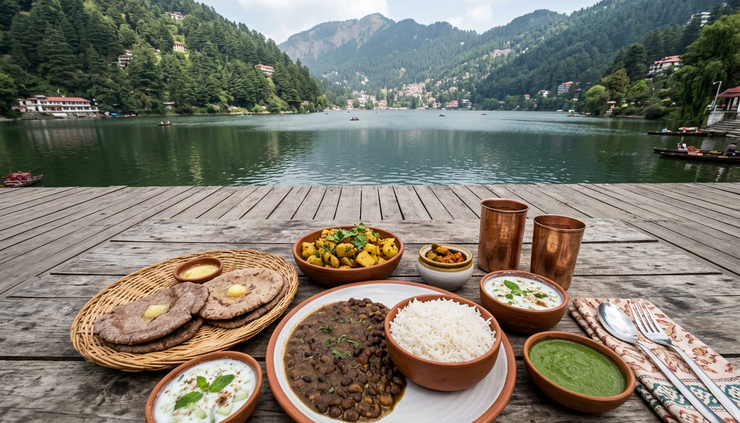
Image shows: Wide-angle view of a traditional Kumaoni meal served near Naini Lake..
Nainital’s cuisine grew from Kumaoni homes and hill station history
Before Nainital became a well-known hill station, the wider Kumaon region had a food culture shaped by altitude, terraced farming and long winters. People cooked what the land gave them. Millets, lentils, local pulses, potatoes, greens, curd, ghee and spices formed the backbone of meals.
This practical food culture still defines many traditional dishes. Ragi, known locally as madua, was valued because it grew well in the hills. Bhatt, a black soybean, became a staple because it was filling and protein-rich. Gahat, also called kulath, was used in dals and winter dishes. Potatoes thrived in the cool climate and became the base of Nainital’s best-loved snack, aloo ke gutke.
Later, as the British developed Nainital as a summer retreat in the 19th century, the town gained bakeries, tea rooms, club-style meals and sweet shops catering to travellers. Boarding schools and tourist traffic added another layer. Over time, local Kumaoni food met North Indian snacks, Indo-Chinese street food, bakery items and Tibetan-influenced dishes such as momos.
That mix explains why a food walk in Nainital can move from a traditional plate of bhatt ki churkani to hot bun maska, from bal mithai to steaming momos, without feeling out of place.
The Famous food of Nanital is not one dish. It is a mix of old Kumaoni comfort food, hill-station snacks and sweets carried home as edible souvenirs.
Traditional dishes carry the taste of Kumaon’s seasons
Nainital’s most meaningful foods are the ones that came from local homes. They were shaped less by luxury and more by climate, community and everyday labour.
Aloo ke gutke are the mountain snack with festival roots
Aloo ke gutke may be the most approachable Kumaoni dish for travellers. Boiled potatoes are cut into chunks, tossed with mustard oil, red chillies, turmeric, coriander and local spices, then finished with coriander leaves. The dish is often served with cucumber raita or bhang ki chutney.
Its charm lies in its simplicity. Potatoes became common in the hills because they stored well and filled the stomach. Aloo ke gutke often appears during local celebrations, picnics, fairs and family gatherings. It is also practical food for cold weather, easy to cook, easy to share and hard to dislike.
Eat it hot, with pahadi raita, and it becomes one of the clearest examples of how Kumaoni cooking turns humble ingredients into something memorable.
Bhatt ki churkani is slow food from the hills
Bhatt ki churkani is made with black soybean, roasted or cooked patiently, then simmered into a thick, dark curry. It is usually eaten with rice. The flavour is nutty, deep and comforting.
This dish matters because it reflects the agricultural strength of Kumaon. Pulses such as bhatt helped families meet their nutritional needs in a region where food had to be seasonal and dependable. The slow cooking style also shows the older rhythm of hill life, where meals were built around hearths, not quick service.
For travellers used to restaurant food, bhatt ki churkani can feel understated at first. Give it time. Its flavour grows with every spoonful.
Ras and dubke show the art of using local pulses
Ras is a traditional Kumaoni preparation made with a mix of pulses, often cooked into a rich, thin curry and eaten with rice. It has the warmth of a home meal and the depth that comes from patient cooking.
Dubke, another pulse-based dish, is usually thicker and softer in texture. Lentils are soaked, ground and cooked into a smooth preparation. These dishes speak to a cuisine that wastes little and values nourishment.
They also reveal why Kumaoni food does not rely on heavy cream or elaborate garnishing. The skill sits in roasting, grinding, tempering and balancing earthy flavours.
Dishes in this image: Close-up of aloo ke gutke with cucumber raita and green chutney.

Image shows: Close-up of aloo ke gutke with cucumber raita and green chutney..
Madua roti brings millet heritage to the table
Madua roti is made from finger millet flour. It has a darker colour, a rustic texture and a hearty taste. Traditionally, it was eaten with ghee, leafy greens, curd or dal.
Millets have long been suited to hill agriculture because they can grow in difficult terrain. Today, as many people rediscover millet-based diets, madua roti has gained new attention. In Nainital, it is not a trend. It is memory on a plate.
A good madua roti tastes of the land it comes from. It may not be soft like wheat roti, but it carries a satisfying weight and warmth.
Kumaoni raita and bhang ki chutney sharpen the plate
Kumaoni raita is usually made with curd, grated cucumber, mustard seeds and spices. It is cooling, sharp and excellent with aloo ke gutke. Bhang ki chutney, made from roasted hemp seeds, is another local favourite. It has a nutty flavour and a gentle bite when mixed with chillies, lemon or other seasonings.
These sides are not afterthoughts. They complete the meal. They show how Kumaoni cooking balances heat, sourness, fat and texture without making the plate crowded.
Nainital’s sweets and snacks reveal its traveller culture
Nainital has always been a town of movement. Pilgrims, students, traders, officials and tourists have passed through it. Food adapted to that movement.
Bal mithai is Kumaon’s famous sweet souvenir
Bal mithai is closely associated with the Kumaon region. It is a brown, fudge-like sweet made from khoya and coated with tiny sugar balls. Its caramel-like flavour and grainy texture make it stand apart from smoother Indian sweets.
The sweet became popular as something that could be carried home from the hills. A box of bal mithai is not just dessert. It is proof of travel, a gift for family, and a reminder of cool air and steep roads.
Many visitors link Nainital with bal mithai even if the sweet is associated with the wider Kumaon region, especially Almora. That is how regional foods travel. They become part of nearby town memories too.
Singori wraps sweetness in leaves
Singori, also called singauri, is made with khoya and wrapped in malu leaves. The leaf is not just packaging. It gives the sweet a delicate aroma and a sense of place.
Before plastic boxes became common, leaves, baskets and cloth were everyday packaging in the hills. Singori preserves that older relationship between food and nature. It looks simple, but the leaf-wrapped form makes it feel ceremonial.
Bun, tea and roadside snacks belong to Mall Road memories
Not every famous food in Nainital is traditional in the strict sense. Tea, bread, pakoras, roasted corn, momos and noodles are part of the town’s lived food culture. A cold evening beside the lake almost demands something hot to hold.
Colonial hill station culture encouraged bakeries and tea habits. Tourism kept them alive. Tibetan and Indo-Chinese snacks became popular because they suit the weather and the walking culture of the town. A plate of momos after boating may not be ancient Kumaoni cuisine, but it is now part of many Nainital memories.
Dishes in this image: Eye-level view of bal mithai and singori displayed in a sweet shop.

Image shows: Eye-level view of bal mithai and singori displayed in a sweet shop..
Food polls make the Nainital plate more personal
Food is never only about recipe lists. It is about the dish someone ate after a long walk, the sweet packed by a grandparent, or the snack shared in the rain. That is why opinion polls fit naturally into any conversation about Nainital food.
Here are a few simple polls to use with family, friends, travel groups or readers.
Poll one asks which dish defines Nainital best
Choice | Why people pick it |
Aloo ke gutke | Spicy, simple and easy to love |
Bhatt ki churkani | Deeply traditional and rooted in Kumaoni homes |
Bal mithai | The classic sweet souvenir of the hills |
Momos by the lake | A modern travel memory for many visitors |
Madua roti | A strong link to millet farming and local food heritage |
If this were your poll, what would win? The answer often changes with age and memory. Older family members may choose bhatt or madua. Students may vote for momos and tea. Travellers may pick bal mithai because it is easy to carry home.
Poll two asks what one must eat on a cold Nainital evening
Choice | Best setting |
Hot tea and pakoras | Rainy walks and lake views |
Aloo ke gutke with raita | Casual lunch after sightseeing |
Steaming momos | Mall Road evenings |
Ras with rice | Slow dinner in a homely setting |
Jalebi or bal mithai | Sweet finish after a market walk |
This poll works well because Nainital’s weather shapes appetite. Cold air makes hot food taste better. Mist makes tea feel necessary. A simple snack can become unforgettable when eaten with numb fingers and a lake in front.
A memory prompt for readers
Think of one Nainital food memory and finish this sentence:
“The dish I remember most from Nainital is ______ because ______.”
It could be bal mithai bought on the last day, corn eaten near the lake, a thali at a small eatery, or tea after climbing to a viewpoint. Personal memories save food from becoming just a checklist.
Culture, faith and everyday life shaped the Nainital table
Nainital’s food culture cannot be separated from Kumaoni life. Many dishes reflect festivals, family kitchens and seasonal work. The use of local grains and pulses came from farming patterns. The love for warming foods came from weather. The habit of sharing sweets came from festivals and travel gifting.
Local fairs and temple visits also influenced food habits. Simple, portable dishes were useful for gatherings. Sweets became tied to celebration. Curd-based sides helped balance spicy food. Lentil dishes offered comfort during cold months.
Then came the town’s public life. Schools, tourism and markets created demand for quick snacks. Restaurants began serving mixed menus because visitors came from across India. That is why Nainital’s food identity is layered. Traditional Kumaoni dishes sit beside pan-Indian favourites, bakery items and noodles.
This does not weaken the cuisine. It makes it honest. A hill town that welcomes travellers will always absorb new tastes. The key is to remember the roots while enjoying the newer additions.
Dishes in this image: Overhead view of a traveller’s food poll card beside plates of Kumaoni dishes.

Image shows: Overhead view of a traveller’s food poll card beside plates of Kumaoni dishes..
How to taste Nainital with more care
A good food trip in Nainital does not need to be complicated. Mix traditional dishes with everyday street snacks and sweets. Ask local eateries if they serve Kumaoni preparations, since some dishes may be seasonal or cooked on request.
Try this simple approach:
Eat one traditional meal Look for bhatt ki churkani, ras, dubke, madua roti or gahat dal.
Choose one snack linked to the town’s mood Aloo ke gutke, tea, pakoras, roasted corn or momos all fit.
Carry one sweet home Bal mithai and singori make the journey last longer.
Ask one local question “What do families here eat in winter?” often leads to better answers than “What is famous?”
Also, do not judge the food only by restaurant presentation. Many Kumaoni dishes are plain-looking. Their strength lies in warmth, texture and memory.
If someone searches for Famous food of Nanital before a trip, the best answer is not a single restaurant list. It is a plate that includes tradition, travel and the slow influence of the hills.
Dishes in this image: Eye-level view of a tea glass and snacks beside a misty Nainital street.

Image shows: Eye-level view of a tea glass and snacks beside a misty Nainital street..
Nainital’s famous foods are loved because they carry more than flavour. Aloo ke gutke speaks of shared plates and local spice. Bhatt ki churkani and ras remember the strength of hill farming. Madua roti keeps millet traditions alive. Bal mithai and singori turn travel into something sweet enough to take home.
The best way to understand Nainital is to taste both its old and new sides. Eat the traditional dishes with patience. Enjoy the snacks without guilt. Ask elders, shopkeepers and cooks what they grew up eating. Then add your own story to the table.
What is your favourite Nainital dish, and what memory comes with it?
Travel, landmark, location, and shop information is based on publicly available online data at the time of writing. Details such as names, addresses, opening hours, availability, prices, and operating status may change. Please verify current details directly with the venue or official source before visiting.
Explore more city food guides
Continue exploring Indian food, landmarks and local markets: Pune · Surat · Srinagar · Leh · Port Blair


Comments