
Famous Foods of Gurugram A Food Lovers Guide to Must Try Local Flavors

Gurugram eats like a city with two appetites. One belongs to old Haryana, with bajra rotis, white butter, chaas, kachri chutney, and slow village-style cooking. The other belongs to a restless urban crowd that wants chole bhature at noon, momos by evening, kebabs after work, and kulfi before heading home.
That mix is what makes the Famous foods of Gurugram so enjoyable. The city does not have one single signature plate. It has markets, malls, highway-style dhabas, sweet shops, cafés, and late-night counters that together create a memorable food trail.
Here is a guide to the dishes worth trying, the stories behind them, and the places that help define Gurugram’s culinary scene.
Dishes in this image: Wide-angle view of a Gurugram street food lane with chaat carts and glowing food stalls
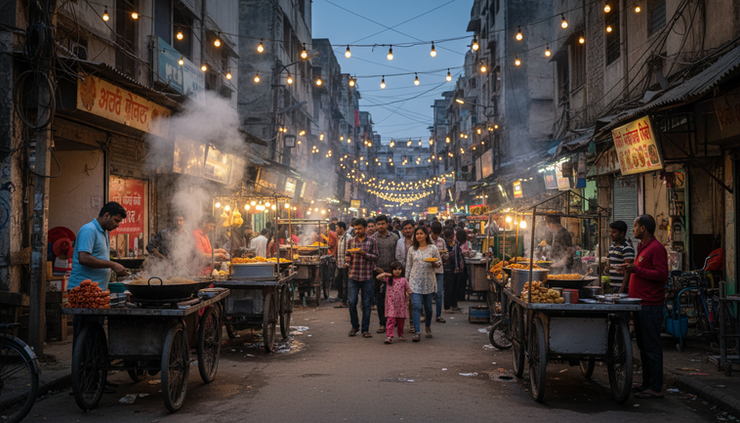
Image shows: Wide-angle view of a Gurugram street food lane with chaat carts and glowing food stalls.
Gurugram’s local roots start with hearty Haryanvi food
Before glass towers and expressways, Gurugram was part of an agrarian belt where food had to be filling, seasonal, and practical. Traditional Haryanvi cooking uses grains, dairy, and simple spices. The flavours are earthy rather than showy, and the food often tastes best when served fresh from a hot tawa.
Bajra roti with white butter
Bajra roti is one of the most rooted foods of the region. Pearl millet grows well in dry conditions, which made it a dependable grain across Haryana and Rajasthan. The rotis are thicker than wheat rotis, slightly nutty, and usually eaten with a large spoon of white butter.
The old way is simple. Break a warm piece of bajra roti, add butter, dip it into curd, dal, or a seasonal sabzi, and let the grain do the work. It is not restaurant drama. It is comfort food with a farming history.
Where to try it: Look for Haryanvi thali counters, dhaba-style restaurants around Old Gurugram, and regional food festivals in the city. Some North Indian restaurants also serve bajra roti in winter menus.
Kachri chutney and seasonal sabzis
Kachri, a small wild melon-like fruit, is widely used in parts of Haryana and Rajasthan. It brings tang and slight bitterness to chutneys. It was also traditionally used as a natural tenderiser for meat in nearby regions.
In Gurugram, kachri chutney is not always easy to find in every restaurant, but it is worth seeking out when a Haryanvi or Rajasthani thali offers it. It pairs beautifully with bajra roti, missi roti, and ghee-rich dishes.
Churma and desi ghee sweets
Churma is made by crushing cooked wheat or millet preparations and mixing them with ghee and jaggery or sugar. It travelled across homes, fields, and festive meals because it could be filling and celebratory at the same time.
In Haryana, ghee is not a garnish. It is often the soul of the dish. That is why churma feels both rustic and indulgent. Try it after a simple meal, not after a heavy butter chicken dinner, so the flavour does not get lost.
Street food brings the city together
If Haryanvi food tells the older story of Gurugram, street food tells the everyday one. Office workers, students, shoppers, and families all meet around chaat counters and tandoors. This is where the city becomes most relaxed.
Dishes in this image: Close-up of an aloo tikki plate topped with curd, chutney, pomegranate, and sev
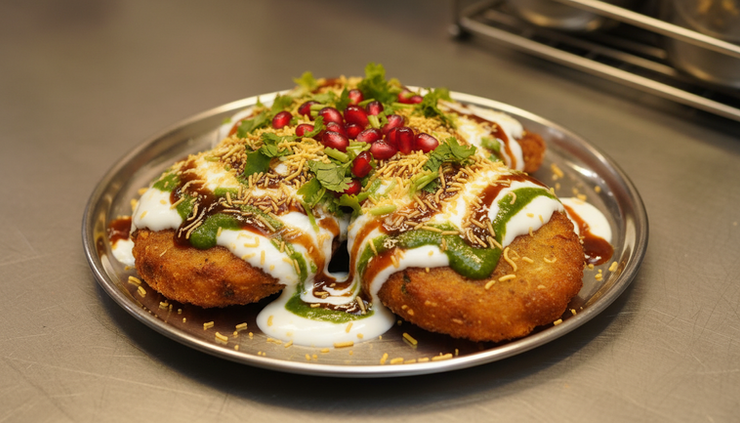
Image shows: Close-up of an aloo tikki plate topped with curd, chutney, pomegranate, and sev.
Aloo tikki chaat
Aloo tikki has roots in the larger North Indian chaat tradition, where textures matter as much as taste. The tikki should be crisp outside, soft inside, and strong enough to hold curd, chutneys, onions, and spices.
The best versions balance four flavours: sweet tamarind, sharp green chutney, creamy curd, and warm masala. Gurugram’s chaat counters often serve it in generous portions, which makes it a meal rather than a snack.
Where to try it: Old Gurugram markets, Sadar Bazaar, Sector 14, and busy sweet shops such as Om Sweets and Bikanervala-style outlets are reliable starting points.
Golgappe and pani puri
Golgappe are theatre in one bite. The vendor cracks the puri, fills it with potato or chickpeas, dips it into spiced water, and hands it over before it collapses. Delhi NCR loves golgappe, and Gurugram has fully embraced that obsession.
The dish has many names across India, including pani puri and puchka. Each version changes the filling, water, and spice level. In Gurugram, the dominant style tends to be North Indian, with tangy, mint-heavy pani and mashed potato filling.
Tip: Ask for one sukha puri at the end. It is the crunchy finale that regulars rarely skip.
Raj kachori
Raj kachori is the grand version of chaat. A large crisp shell is filled with sprouts, potatoes, curd, chutneys, sev, and spices. Its popularity rose through sweet shops and chaat houses that turned snack food into sit-down dining.
It is a must-try for anyone exploring the Famous foods of Gurugram because it shows how the city likes its food: layered, generous, and made for sharing.
Where to try it: Haldiram’s, Bikanervala, and large sweet shops across Gurugram usually serve dependable raj kachori.
Ram laddoo
Despite the name, ram laddoo is not a sweet. It is a savoury snack made from fried moong dal batter, topped with grated radish, green chutney, and masala. It is closely associated with Delhi’s street food culture, and Gurugram’s proximity to Delhi helped bring it into local markets.
Freshness matters here. The laddoos should be hot, light, and crisp, while the radish should add cool crunch. It is the kind of snack that disappears quickly from a paper plate.
North Indian favourites rule lunch tables and late evenings
Gurugram’s busiest food areas, Cyber Hub, Sector 29, Golf Course Road, 32nd Avenue, Galleria Market, and Ambience Mall, show how much the city loves North Indian comfort food. Some dishes came from Punjab, some from Delhi, and some from older Mughlai kitchens, but Gurugram has made them its own through sheer demand.
Dishes in this image: Eye-level view of chole bhature served with onions, pickle, and green chilli on a metal plate

Image shows: Eye-level view of chole bhature served with onions, pickle, and green chilli on a metal plate.
Chole bhature
Chole bhature is one of North India’s most loved combinations. The chickpeas are slow-cooked with spices until dark and rich, while the bhature puff up into airy, golden bread. The dish is linked strongly with Punjabi kitchens and Delhi’s post-partition food culture, when refugee-run eateries shaped much of the capital’s popular food identity.
In Gurugram, chole bhature works as breakfast, lunch, and a weekend craving. The city’s sweet shops and casual restaurants do brisk business with plates that arrive with pickle, onions, and green chilli.
Where to try it: Om Sweets is a familiar name for many locals. Bikanervala and Haldiram’s are also popular options for a clean, consistent version.
Parathas with curd and pickle
Parathas are not just food in North India. They are a habit. Aloo, gobhi, paneer, mooli, and mixed parathas all make regular appearances on Gurugram tables.
The history is practical. Stuffed breads could carry flavour, grain, and energy in one package. Farmers, travellers, and office-goers have all found their reasons to love them.
Where to try it: Small breakfast counters in Old Gurugram, dhabas on the edges of the city, and casual North Indian eateries around Sector 15, Sector 31, and Golf Course Road.
Butter chicken
Butter chicken was born in Delhi, widely credited to the kitchens of Moti Mahal, where leftover tandoori chicken was simmered in a tomato, butter, and cream gravy. Gurugram adopted it naturally because the city’s dining habits are closely tied to Delhi NCR.
The dish works because it softens smoke with richness. Tandoori chicken brings char. The gravy brings sweetness, tang, and comfort. Order it with butter naan and it becomes the kind of meal people remember after a long workday.
Where to try it: North Indian restaurants in Cyber Hub, Sector 29, and Golf Course Road usually offer it. Dhaba-style places often serve a bolder, less sweet version.
Kebabs and tikkas
Kebabs carry a long history from Central Asian, Persian, and Mughal cooking traditions, shaped further by Indian spices and tandoor techniques. Gurugram’s kebab culture ranges from seekh kebabs and chicken tikka to paneer tikka and soya chaap.
Soya chaap deserves special mention. It gained popularity across Delhi NCR as a vegetarian street-style answer to tandoori snacks. When marinated well and charred at the edges, it offers smoky flavour without meat.
Where to try it: Explore Sector 29, Golf Course Road, and popular food markets. For casual cravings, tandoori counters in local markets often surprise with excellent chaap and tikka.
Cafés, global plates, and modern Indian cooking show Gurugram’s newer side
Gurugram’s food story changed when corporate offices, residential towers, and shopping districts brought people from across India and beyond. The city became comfortable with sushi, Vietnamese bowls, Italian pasta, South Indian filter coffee, artisanal desserts, and regional Indian menus.
Modern Indian small plates
Restaurants such as Comorin have helped put Gurugram on the map for polished Indian dining without making the food feel distant. Modern Indian cooking often takes familiar flavours, like chutneys, pickles, chaats, kebabs, and regional curries, and serves them in a new format.
The interesting part is not the plating alone. It is the way these restaurants revive older ingredients and techniques for a new audience. A chutney, a millet, or a pickle can tell as much of a story as a main course.
Momos and Tibetan-inspired snacks
Momos came into Delhi NCR through Tibetan and Nepali communities and became one of the region’s most loved street foods. Gurugram took to them quickly, especially in market lanes and near office areas.
Steamed momos are the classic choice, but tandoori momos are the NCR twist. They show how the region absorbs a dish and then puts it through the tandoor with cream, masala, and char.
Where to try it: Local markets around Sector 14, Galleria Market, and food courts often have momo stalls. Pick busy counters where the turnover is high.
South Indian breakfasts
Gurugram’s migrant population has made dosa, idli, vada, and filter coffee part of the city’s everyday food map. The history of dosa goes back centuries in South India, with different regions shaping different textures and fillings.
In Gurugram, South Indian food is a weekend breakfast favourite. A crisp masala dosa with coconut chutney and sambar feels light, filling, and reliable.
Where to try it: Carnatic-style and Udupi-style restaurants in Delhi NCR, mall food courts, and dedicated South Indian outlets across Gurugram.
Dishes in this image: Top-down view of dosa, chutneys, sambar, and filter coffee on a banana leaf-style plate

Image shows: Top-down view of dosa, chutneys, sambar, and filter coffee on a banana leaf-style plate.
Sweets and drinks complete the Gurugram food trail
No food guide to Gurugram feels complete without sweets. The city’s dessert culture leans heavily on North Indian favourites, but it also welcomes newer bakery and café desserts.
Jalebi with rabri
Jalebi is believed to have travelled to India through West Asian culinary routes before becoming deeply Indian in its many regional forms. In North India, it is eaten hot, often with rabri or milk.
The best jalebi has a crisp outer ring and syrup inside that bursts as you bite. Rabri adds slow-cooked milk richness, which turns a street sweet into a full dessert.
Where to try it: Old Gurugram sweet shops, Sadar Bazaar, and established sweet chains during mornings or evenings.
Kulfi and falooda
Kulfi is older than modern ice cream in India and is often linked to Mughal-era frozen desserts, when ice and saltpetre helped chill sweetened milk mixtures. Unlike whipped ice cream, kulfi is dense because it is made from reduced milk.
In Gurugram, kulfi falooda is a summer favourite. The cold kulfi, silky falooda strands, rose syrup, and nuts make it cooling but still indulgent.
Where to try it: Sweet shops, street dessert carts, and North Indian restaurants after dinner.
Lassi and chaas
Dairy has always been central to Haryana’s food culture. Lassi is thick, sweet, and filling. Chaas is lighter, salted, and often spiced with roasted cumin.
For a food walk, chaas makes more sense because it refreshes the palate between heavier dishes. For a standalone treat, a tall glass of lassi is hard to beat.
A simple Gurugram food trail for one satisfying day
If the choices feel too many, follow this route:
Time | What to eat | Where to look |
Morning | Paratha or chole bhature | Old Gurugram, Om Sweets, local breakfast counters |
Afternoon | Haryanvi thali or bajra roti | Dhaba-style restaurants and regional menus |
Evening | Aloo tikki, golgappe, raj kachori | Sadar Bazaar, Sector 14, large sweet shops |
Dinner | Butter chicken, kebabs, chaap, or modern Indian plates | Cyber Hub, Sector 29, 32nd Avenue, Golf Course Road |
Dessert | Jalebi rabri, kulfi, or lassi | Sweet shops and dessert carts |
A few practical tips make the trail better:
Choose busy stalls, especially for chaat and momos.
Ask for spice levels before ordering tandoori snacks.
Visit old markets for street food and newer dining districts for sit-down meals.
Share dishes, because Gurugram portions can be generous.
Keep room for dessert, since sweets are a major part of the experience.
Dishes in this image: Close-up of jalebi being lifted from a kadai beside a bowl of rabri

Image shows: Close-up of jalebi being lifted from a kadai beside a bowl of rabri.
Gurugram’s food is not limited to one old recipe or one famous lane. Its charm lies in the mix. A plate of bajra roti can sit in the same city as Korean barbecue, Punjabi chole, tandoori momos, and modern Indian small plates. That range is exactly why the Famous foods of Gurugram deserve more attention from anyone who loves eating with curiosity.
Start with one market, one sweet shop, or one dhaba meal. Then keep going. Gurugram rewards the hungry explorer, one crisp tikki, smoky kebab, and spoonful of rabri at a time.
Travel, landmark, location, and shop information is based on publicly available online data at the time of writing. Details such as names, addresses, opening hours, availability, prices, and operating status may change. Please verify current details directly with the venue or official source before visiting.
Explore more city food guides
Continue exploring Indian food, landmarks and local markets: Pune · Surat · Srinagar · Leh · Port Blair


Comments