
Famous Foods of Shilong A Journey Through History Culture and Local Flavors

Shillong does not reveal its food all at once. It appears in steam rising from bamboo baskets, pork simmering with black sesame, rice powder pressed by hand, and fermented soybeans wrapped in leaves. The city’s food carries the memory of Khasi homes, Jaintia villages, Garo kitchens, hill markets, and trade routes that brought new flavours into the plateau.
The Famous foods of Shilong are often simple in appearance, but they are rich in meaning. Many dishes grew from practical hill life, where rice, smoked meat, wild herbs, bamboo shoots, and fermented ingredients helped families eat well through rain, cold, and long agricultural seasons. Today, these foods still hold a place at markets, family tables, festivals, and roadside stalls across Meghalaya’s capital.
Dishes in this image: Wide-angle view of a Shillong market food stall with local rice dishes and pork curries

Image shows: Wide-angle view of a Shillong market food stall with local rice dishes and pork curries.
Shillong’s food story begins with rice, pork, smoke, and fermentation
Shillong sits in the Khasi Hills, but its food identity is shaped by many communities. Khasi cooking forms the heart of the city’s traditional table, while Jaintia and Garo influences add their own flavours. Over time, Nepali, Bengali, Assamese, Tibetan, and wider North East Indian food traditions also entered the city through migration, trade, schools, markets, and neighbourhood eating places.
At the centre of many local meals is rice. It is not only a staple but also a ritual food. Rice appears boiled, powdered, steamed, fermented, and cooked with meat. Pork is equally important in many Khasi homes, especially during community gatherings and celebrations. Smoking, boiling, slow cooking, and fermenting are common methods because they suit the region’s cool climate and older ways of preserving food.
Shillong food is rarely overloaded with spices. Instead, it depends on deep, earthy flavours from:
Black sesame seeds
Fermented soybeans
Bamboo shoots
Local chillies
Ginger and garlic
Wild herbs and leafy greens
Smoked or dried meat
Short-grain and sticky varieties of rice
A Khasi home cook may describe it simply: the food should taste of the ingredient first. That thought explains much of Shillong’s culinary charm. Heat, salt, smoke, and fermentation guide the dish, but they do not hide its base flavour.
Jadoh is the red rice dish at the heart of Khasi feasts
Jadoh is one of the best-known dishes from Shillong and the wider Khasi region. The name is commonly linked to two Khasi words, with “ja” referring to rice and “doh” referring to meat. In everyday terms, it is a rice and meat dish, most often made with pork, though variations exist.
Its roots lie in Khasi domestic and ceremonial cooking. Jadoh has long been associated with feasts, family gatherings, and community occasions. In the past, when a household prepared meat for a special event, rice cooked with that meat became a practical and flavourful way to feed many people. The dish also reflects a no-waste approach, where different cuts of meat and broth could enrich the rice.
Traditional jadoh often uses short-grain rice, pork, onions, ginger, garlic, turmeric, and sometimes pork blood, which gives a deeper colour and flavour. Not every cook uses blood today, especially in restaurants, but old-style versions still carry that rich, savoury depth.
The cooking method is simple but careful. Meat is cooked first to release fat and juices. Rice is then added so it absorbs the stock. The result is not a biryani and not a pulao in the usual North Indian sense. Jadoh has its own identity, more earthy than fragrant, more comforting than decorative.
A typical plate may include jadoh with:
Dohneiiong, a pork dish with black sesame
Boiled vegetables
Tungrymbai
Pickled bamboo shoot
A sharp chilli chutney
For many visitors asking about the famous foods of Shilong, jadoh is the first dish to try because it explains the city’s food character in one plate.
Dishes in this image: Close-up of jadoh served with pork and chilli chutney on a banana leaf
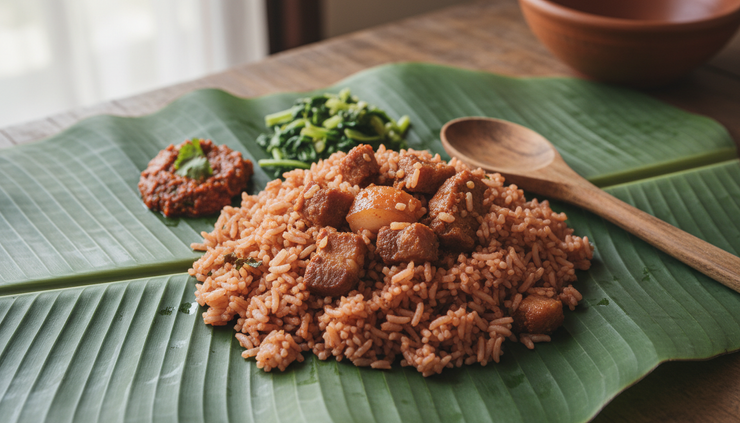
Image shows: Close-up of jadoh served with pork and chilli chutney on a banana leaf.
Dohneiiong shows the power of black sesame
Dohneiiong is one of Shillong’s most memorable pork dishes. The word is usually understood through Khasi food terms, with “doh” meaning meat and “neiiong” referring to black sesame. The dish is dark, nutty, and deeply savoury, with a flavour that stays long after the meal.
Its origin belongs to Khasi kitchens where pork held social and festive importance. In many hill communities, pork was not just an everyday protein. It was part of community feasts, rituals, weddings, and gatherings. Black sesame, grown and used across parts of the North East, gave the dish both flavour and body.
The method matters. Black sesame seeds are roasted and ground into a paste or powder. This step releases their oil and aroma. Pork is cooked with ginger, garlic, onion, local spices, and the sesame paste. Some versions are dry and thick, while others carry a little gravy. The best versions balance fat, nuttiness, and gentle heat.
Dohneiiong is not a dish that tries to impress through complexity. Its strength is focus. The sesame does most of the work. It coats the pork and turns the dish almost charcoal-black. This colour surprises many first-time eaters, but in Shillong, it signals comfort and celebration.
Local cooks often stress patience with this dish. If the sesame is not roasted well, the flavour stays flat. If it is roasted too much, bitterness takes over. The cooking sits in that narrow, skilled space where home knowledge matters.
Tungrymbai carries the old wisdom of fermentation
Tungrymbai is made from fermented soybeans and is one of the most distinctive foods in Khasi cuisine. It has a strong aroma, a soft texture, and a flavour that can be nutty, savoury, and slightly sharp. Like many fermented foods across the world, it can be unfamiliar at first, then deeply comforting once understood.
The history of tungrymbai is tied to preservation. In a rainy hill region, fermentation helped households store and transform ingredients. Soybeans could be boiled, wrapped, left to ferment, and later cooked into a hearty preparation. This technique gave families protein-rich food with a long-lasting flavour.
Tungrymbai is usually cooked with pork, onion, ginger, garlic, chillies, and sometimes black sesame or local spices. It can be mashed, fried, simmered, or cooked into a thick, rustic mixture. The dish is often eaten with plain rice, which balances its strong taste.
Culturally, tungrymbai represents the Khasi gift for turning humble ingredients into something memorable. It also connects Shillong to a larger North East Indian love of fermented foods, where bamboo shoots, fish, soybeans, and leafy greens are preserved in different ways across states and communities.
A small personal moment often reported by travellers is the first encounter with its smell at a market stall. The aroma may feel intense, but the taste is warmer and more rounded than expected. That is the point of tungrymbai. It asks for curiosity.
Dishes in this image: Eye-level view of fermented soybeans and tungrymbai being prepared in a Khasi kitchen

Image shows: Eye-level view of fermented soybeans and tungrymbai being prepared in a Khasi kitchen.
Pumaloi and putharo keep rice at the centre of daily life
Not every famous Shillong food is meat-heavy. Pumaloi and putharo show the softer, quieter side of Khasi cooking.
Pumaloi is steamed rice flour shaped by hand
Pumaloi is a steamed rice flour dish, often prepared in a special pot or steamer. It is made from powdered rice and has a soft, grainy texture. Unlike sweet rice cakes in some parts of India, pumaloi is usually plain and is eaten with savoury dishes.
Its history goes back to household cooking, where rice could be ground and steamed for a filling meal. The method uses few ingredients, but it needs a good feel for texture. If the rice flour is too dry, the dish becomes crumbly. If it is too wet, it turns heavy.
Pumaloi is often eaten with pork gravies, vegetable preparations, or chutneys. Its plainness is its value. It absorbs flavour and gives balance to richer dishes like dohneiiong.
Putharo is a rice bread with festival roots
Putharo is another rice-based Khasi food, often described as a kind of rice cake or bread. It is usually made with rice flour and cooked on a pan or traditional surface. It may be served with meat dishes, tea, or local accompaniments.
Putharo reflects a practical style of hill cooking. Rice flour could be turned into something portable, warm, and filling. In many homes, such foods also carried a festive feeling because they required extra preparation and were often cooked for guests or special days.
Both pumaloi and putharo show that Shillong cuisine is not only about strong flavours. It also values texture, warmth, and the comfort of rice in many forms.
Dohkhlieh and nakham bitchi bring freshness and heat to the table
Shillong’s food culture includes dishes that cut through richness. Dohkhlieh and nakham bitchi are good examples, though they come from different community traditions within Meghalaya’s wider food culture.
Dohkhlieh is a Khasi pork salad with bite
Dohkhlieh is often described as a pork salad. It usually uses boiled pork, onion, chillies, ginger, and sometimes local herbs. Some versions include pig brain for extra richness, though many modern versions keep it simpler.
The dish likely emerged from the Khasi habit of using boiled meat in direct, flavourful ways. Instead of heavy spice, dohkhlieh depends on freshness and contrast. The pork is mild, the onion is sharp, and the chilli adds heat.
Dohkhlieh is culturally important because it fits both home meals and social gatherings. It can be served as a side dish, a snack, or part of a larger spread. It also shows how Khasi cooking can be clean and bright without losing intensity.
Nakham bitchi reflects Garo influence in Shillong
Nakham bitchi is associated with Garo cuisine and is widely known in Meghalaya. It is a dry fish soup or broth, often flavoured with chillies and sometimes a touch of soda or alkaline element in traditional versions. In Shillong, where communities meet and share food, it has become part of the broader city experience.
The dish comes from a culture that values preserved fish and sharp, warming broths. Dry fish adds depth, while chilli gives heat. It is often served before a meal or with rice, especially in colder weather.
Nakham bitchi matters because it reminds us that Shillong food is not one single tradition. The city gathers flavours from across Meghalaya, and each community adds something to the shared table.
Momos, chowmein, and tea tell the story of a changing hill city
No honest food walk through Shillong can skip momos, chowmein, and tea stalls. These may not be ancient Khasi dishes, but they are now part of the city’s everyday food rhythm.
Momos reached Shillong through Tibetan, Nepali, and broader Himalayan influences. Over time, they became a favourite street food, especially in colder weather. Steamed dumplings filled with meat or vegetables suit the climate perfectly. They are warm, affordable, and easy to eat on the move.
Chowmein and other noodle dishes also found a place in Shillong through Chinese-influenced cooking and local adaptations. Roadside versions may use cabbage, spring onions, local chillies, and simple sauces. They are not traditional in the same way as jadoh or dohneiiong, but they show how the city absorbs and reshapes outside influences.
Then there is tea. In Shillong, tea is less a dish and more a pause. It appears with putharo, snacks, conversations, rain, and music. Red tea, milk tea, and lemon tea all have their place. Around Police Bazar, Laitumkhrah, and local neighbourhoods, tea shops often become informal food maps. Someone ordering a plate of momos may also be discussing where to find the best jadoh.
This mix of old and new is why the famous foods of Shilong remain so interesting. The city protects traditional flavours but keeps making room for new cravings.
Dishes in this image: Overhead view of steamed momos and red tea on a small table in Shillong

Image shows: Overhead view of steamed momos and red tea on a small table in Shillong.
What makes Shillong food unique
Shillong’s food stands apart because it trusts local ingredients and older techniques. The dishes are not built around heavy masalas. They rely on smoke, fermentation, boiling, roasting, and slow cooking.
A few qualities define the cuisine:
Fermented depth Tungrymbai and bamboo shoot preparations bring flavour that cannot be rushed.
Rice in many forms Jadoh, pumaloi, and putharo show how one staple can become many different foods.
Pork as a cultural food Pork appears in everyday meals and special occasions, especially in Khasi cooking.
Minimal spice, strong character Ginger, garlic, chilli, sesame, and local herbs do the work without crowding the dish.
Community influence Khasi, Jaintia, Garo, Nepali, Tibetan, Bengali, and other food traditions meet in Shillong.
For a first meal in the city, a balanced plate would include jadoh, dohneiiong, a small serving of tungrymbai, boiled greens, and chilli chutney. For a lighter start, try putharo with tea, then move to momos or dohkhlieh later in the day.
The beauty of Shillong’s food is that it feels rooted. Each dish carries a reason for being there, whether it came from preservation, farming, ritual, weather, trade, or the need to feed a large family well. To understand the city, follow the steam from a rice pot, the smell of roasted sesame, and the sharp warmth of chilli in the air. That is where Shillong’s history is still being served.
Travel, landmark, location, and shop information is based on publicly available online data at the time of writing. Details such as names, addresses, opening hours, availability, prices, and operating status may change. Please verify current details directly with the venue or official source before visiting.
Explore more city food guides
Continue exploring Indian food, landmarks and local markets: Pune · Surat · Srinagar · Leh · Port Blair


Comments