
Famous Foods of Imphal History and Cultural Background of Iconic Local Flavors

Imphal’s food does not shout for attention. It draws you in with smoke, steam, fermented fish, black rice, wild herbs, and the clean heat of local chillies. A simple meal of rice, eromba, singju, and a light vegetable stew can tell you more about the Manipur valley than a long lecture ever could.
The capital city sits in the Imphal Valley, with hills around it and wetlands not far away. That geography shaped the kitchen. Rice became the base. Fish from rivers, ponds, and Loktak Lake became everyday protein. Seasonal greens, bamboo shoots, yongchak, lotus stems, and herbs gave dishes their fragrance. Fermentation helped preserve food through changing seasons and added the deep savoury taste now linked with many Meitei meals.
The famous foods of Imphal are not just recipes. They are tied to markets, home kitchens, ritual meals, women’s labour, farming cycles, and community gatherings. To understand them, it helps to see the food as part of Imphal’s social memory.
Dishes in this image: Wide-angle view of a traditional Imphal food spread served on banana leaves
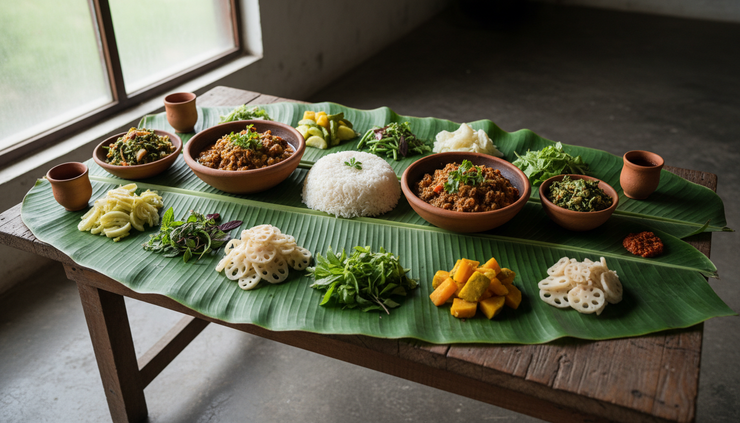
Image shows: Wide-angle view of a traditional Imphal food spread served on banana leaves.
Imphal’s food history begins with rice, fish, and fermentation
The food history of Imphal starts with the land. The valley’s fertile soil made rice central to daily life. A Manipuri meal usually turns around rice, not bread. Even when the side dishes are bold, smoky, or spicy, the plate feels balanced because rice anchors everything.
Fish has long held a special place in the valley diet. Fresh fish appears in curries and stews, while fermented fish, locally known as ngari, gives depth to many iconic dishes. Ngari is not used like a garnish. It acts like a flavour foundation. A small amount can change a dish completely, giving it a sharp, earthy, savoury character.
Fermented ingredients are one of the most important features of Manipuri cooking. They grew from practical needs, but over time they became a matter of taste and identity. Along with ngari, Imphal kitchens use fermented bamboo shoot, known as soibum, and fermented soybean, often called hawaijar. These ingredients bring strong aromas that may surprise first-time eaters, but they also create the flavours many locals associate with comfort.
The city’s food culture also reflects movement between valley and hill communities. Ingredients such as bamboo shoots, herbs, smoked foods, and chillies show the exchange of food knowledge across Manipur. Imphal’s markets carry this mix every day.
A key place in that story is Ima Keithel, the famous women-run market in Imphal. For generations, women vendors have sold fish, greens, rice, spices, hand-pounded ingredients, snacks, and cooked foods. The market is not only a place to buy dinner. It is a living archive of local food habits.
Eromba and singju show the soul of everyday cooking
Some dishes are so common in homes that they become part of a place’s identity. In Imphal, eromba and singju hold that place.
Eromba brings fire, softness, and fermented depth
Eromba is one of the best-known dishes of Manipur. At its simplest, it combines boiled vegetables with chilli and fermented fish. The vegetables may include potatoes, colocasia, bamboo shoots, yongchak, or seasonal greens. The ingredients are mashed together, then finished with local herbs.
The dish has a rustic texture. It is not smooth like a restaurant purée. It feels hand-made, direct, and honest. The heat comes from chillies, often strong local varieties, while ngari gives it a deep savoury base.
Eromba shows how Manipuri food uses very few ingredients to create serious flavour. It also shows the cultural preference for boiled and lightly handled food. Many everyday dishes avoid heavy oil and thick spice pastes. Instead, they depend on freshness, fermentation, chilli, and herbs.
Eromba is usually eaten with rice. It can sit beside a mild stew, a salad, or fried fish. In many homes, it is not treated as a special dish. It is the sort of food people crave when they are away from home.
Singju is a salad with memory and bite
Singju is often described as a Manipuri salad, but that word does not fully explain it. It is crisp, spicy, nutty, and aromatic. It can include shredded cabbage, lotus stem, banana flower, herbs, pea shoots, yongchak, and seasonal vegetables. Roasted gram flour or perilla seeds may add body. Chilli and fermented fish can bring heat and depth.
Singju has many versions. Some are vegetarian. Some include ngari. Some are dry and crunchy, while others feel moist and intense. Street-side singju often has a more playful quality, made for quick eating and strong flavour.
Culturally, singju reflects the Manipuri skill of using raw and lightly prepared ingredients. It also shows Imphal’s love for texture. A good singju is not only about spice. It should crunch, soften, warm the mouth, and leave a nutty aftertaste.
Dishes in this image: Close-up of eromba and singju served with rice in small bowls

Image shows: Close-up of eromba and singju served with rice in small bowls.
Stews, herbs, and boiled dishes define home-style Imphal meals
While outsiders may first notice the fiery dishes, many Imphal meals are built around gentle stews. These dishes are nourishing, light, and closely tied to home cooking.
Chamthong or kangshoi is comfort in a bowl
Chamthong, also known by many as kangshoi, is a clear vegetable stew. It may include seasonal greens, potatoes, mushrooms, peas, pumpkin, or other local vegetables. Some versions use dried or fermented fish, while others remain vegetarian.
The dish is usually not oily. Its flavour comes from vegetables, herbs, chilli, and sometimes ngari. It is served hot with rice, especially as part of a daily meal.
Chamthong tells us that Manipuri food is not always intense. It can be calm and subtle. In a climate where people eat rice daily, a light stew helps balance spicier dishes on the plate.
Ooti carries the influence of ritual and vegetarian cooking
Ooti is another important dish, often made with peas, lentils, or pulses. It uses soda or alkaline water in some traditional preparations, which gives the dish a distinct texture and taste. Ooti is especially linked with vegetarian meals and festive cooking in many Meitei households.
The growth of Vaishnav traditions in Manipur shaped parts of the valley’s food culture. Vegetarian feasts became important in religious and social settings. Dishes like ooti, rice preparations, vegetable curries, and sweets gained a strong place in ritual meals.
This does not mean older food practices disappeared. Instead, Imphal’s food culture learned to hold different strands together. Fermented fish, fresh fish, vegetarian offerings, rice sweets, and herbal stews all exist within the same food world.
Morok metpa proves the power of simplicity
Morok metpa is a chilli chutney or mash. It often combines roasted or boiled chillies with fermented fish, salt, and sometimes herbs. It is strong, direct, and meant to be eaten in small amounts with rice.
This dish captures a key idea in Imphal cooking. A side dish does not need many ingredients to feel complete. When the chilli is good and the ngari is well prepared, morok metpa can carry an entire meal.
Snacks and market foods reveal Imphal’s social life
Food in Imphal is not limited to the household meal. Markets, roadside stalls, tea shops, and evening snack corners have their own charm. These foods show how people gather, talk, and eat between daily tasks.
Dish | What it is | Cultural role |
Paknam | A steamed or pan-cooked cake made with gram flour, herbs, chilli, and often fish or fermented fish | Popular as a snack and home-style side dish |
Chak-hao kheer | A sweet pudding made with black rice and milk | Common at celebrations and special meals |
Kabok | Puffed or roasted rice snack | Linked with festive and everyday snacking |
Nga-thongba | Fish curry with local herbs and spices | A familiar dish in fish-loving households |
Hawaijar | Fermented soybean used in dishes or chutneys | Shows the wider love for fermented foods |
Paknam is a savoury cake with local character
Paknam is one of Imphal’s most memorable snacks. It is often made with besan or gram flour, herbs, chilli, and fish-based flavouring. The mixture is wrapped in leaves or shaped, then steamed, roasted, or cooked on a pan depending on the style.
Its texture can be firm, moist, and slightly crumbly. Its flavour is smoky, spicy, and savoury. Paknam works as a snack, but it can also appear as part of a meal with rice.
The leaf wrapping matters. It gives aroma and links the food to older cooking methods, where leaves, fire, and steam were central tools in the kitchen.
Chak-hao turns black rice into celebration food
Chak-hao, Manipur’s famous black rice, has a deep purple-black colour that turns rich and glossy when cooked. It appears in sweet dishes, especially chak-hao kheer, where the rice cooks with milk and sugar.
Black rice has cultural value beyond taste. It is associated with special occasions, hospitality, and festive meals. Its fragrance and colour make it stand out from everyday white rice.
Chak-hao kheer also shows how Imphal’s food culture includes delicate sweets, not only spicy dishes. It is soft, aromatic, and visually striking. For many visitors, it becomes one of the easiest entry points into Manipuri flavours.
Dishes in this image: Eye-level view of chak-hao kheer in a clay bowl with black rice grains visible

Image shows: Eye-level view of chak-hao kheer in a clay bowl with black rice grains visible.
Ingredients carry cultural meaning in Imphal’s kitchen
The iconic flavours of Imphal come from ingredients that carry history. Each one speaks of preservation, agriculture, wetlands, gardens, or markets.
Ngari is central because it connects food with time. Fresh fish feeds a household today. Fermented fish carries the season forward. Its smell can be strong, but its role is deeply respected in the kitchen.
Soibum, fermented bamboo shoot, brings tang and aroma. Bamboo is common across the North East, and its shoots appear in many regional cuisines. In Imphal, soibum often adds character to stews, curries, and vegetable dishes.
Yongchak, also called tree bean, appears in singju, eromba, and other preparations. It has a strong smell and a devoted following. Its use shows how local taste values ingredients that are bold rather than mild.
Local herbs are equally important. Manipuri cooking often uses herbs not as decoration, but as flavour. They freshen mashed dishes, lift stews, and balance fermented notes.
Chillies bring heat, yet they also bring personality. The chilli in Manipuri food is not only about burning the tongue. It can be smoky, fruity, sharp, or earthy depending on how it is handled.
This ingredient culture explains why the famous foods of Imphal can taste so different from mainstream North Indian food. The cooking uses less dairy, less heavy oil, and fewer powdered spice blends. The flavour comes from a different grammar.
Food, faith, festivals, and community shape the Imphal table
Meals in Imphal reflect community life. Food marks rites, welcomes guests, supports festivals, and strengthens family ties. A plate may change depending on whether it is for a daily lunch, a ritual meal, a wedding, a market snack, or a festival gathering.
During important social and religious events, vegetarian dishes often play a major role among Meitei communities influenced by Vaishnav food practices. Rice, pulses, vegetables, ooti, sweets, and specific preparations may appear in organised meals. These foods are served with order and care, showing respect for guests and tradition.
At the same time, fish and fermented ingredients remain deeply present in everyday life. This balance gives Imphal its layered food identity. The city does not fit into one simple category. It is devotional and earthy, subtle and fiery, vegetarian and fish-loving, old and changing.
The role of women deserves special attention. From home kitchens to Ima Keithel, women have preserved, adapted, and traded the ingredients that define Imphal’s food. Recipes are often learned by watching, tasting, and helping rather than reading written instructions. That passing of knowledge keeps dishes alive even when exact methods differ from home to home.
Food also builds connection between valley and hill communities. Markets bring together produce, herbs, bamboo shoots, smoked items, chillies, and seasonal foods from different parts of Manipur. Imphal’s table carries that shared geography.
Dishes in this image: Overhead view of women arranging vegetables and local ingredients at an Imphal market stall

Image shows: Overhead view of women arranging vegetables and local ingredients at an Imphal market stall.
How to experience iconic Imphal flavours with respect
The best way to approach Imphal’s food is with curiosity. Some flavours, especially ngari, soibum, hawaijar, and yongchak, may feel unfamiliar at first. Give them time. These ingredients are not oddities. They are part of a long food culture built around climate, preservation, local produce, and memory.
A good first meal could include:
Steamed rice with eromba
Singju for crunch and heat
Chamthong or kangshoi for balance
Paknam as a savoury snack
Chak-hao kheer for a sweet finish
If strong fermented flavours feel new, start with milder dishes like chamthong, ooti, nga-thongba, or chak-hao kheer. Then move towards eromba, morok metpa, singju with ngari, and dishes using soibum or hawaijar.
It also helps to eat these foods together, not in isolation. Eromba makes more sense with rice. Morok metpa works as a small punch beside a larger meal. Singju tastes better when its crunch breaks the softness of rice and stews. Manipuri food values balance across the plate.
The famous foods of Imphal are powerful because they remain close to daily life. They do not depend on luxury ingredients or elaborate restaurant techniques. They come from rice fields, wetlands, gardens, hearths, markets, and inherited skill.
To eat in Imphal is to taste a city shaped by land and community. Its iconic local flavours carry stories of preservation, devotion, trade, women’s work, and seasonal abundance. Start with one plate of rice and eromba, add singju on the side, finish with chak-hao kheer, and the history of the valley begins to feel wonderfully edible.
Travel, landmark, location, and shop information is based on publicly available online data at the time of writing. Details such as names, addresses, opening hours, availability, prices, and operating status may change. Please verify current details directly with the venue or official source before visiting.
Explore more city food guides
Continue exploring Indian food, landmarks and local markets: Pune · Surat · Srinagar · Leh · Port Blair


Comments