
Famous Foods of Daman A Flavorful Journey Through Local Dishes and Hidden Stories

Daman does not announce its food with noise. It lets the aroma of fried fish, coconut curry, hot bhajiyas, and soft pav do the talking.
This small coastal destination, tucked between Gujarat and the Arabian Sea, has a table shaped by many hands. Gujarati kitchens bring farsan, sev, gram flour snacks, and mild sweetness. Fishing communities bring the morning catch. Centuries of Portuguese presence left traces of vinegar, chilli, garlic, and slow-cooked meat and seafood. Travellers often come for the beaches, forts, and quiet lanes, but the famous foods of Daman are reason enough to stay longer.
The best way to understand Daman is to eat across it slowly. Start with fish by the sea, try spicy prawns at a homely place, follow the evening crowd to a street stall, and end with something sweet and local. The food is simple, but the stories behind it are layered.
Dishes in this image: Wide-angle view of a Daman seaside food stall serving fried fish and tea

Image shows: Wide-angle view of a Daman seaside food stall serving fried fish and tea.
Daman’s food has roots in the coast, Gujarat, and Portuguese kitchens
Daman’s location explains much of its food. The sea provides fish, prawns, crabs, and shellfish. Gujarat brings vegetarian snacks, lentils, pickles, and the love of balancing sweet, sour, salty, and spicy flavours. Portuguese-era cooking adds vinegar, garlic, dried red chillies, and marination techniques that still show up in coastal homes.
A local home cook once described Daman’s food as “what happens when fish meets patience.” She was talking about curry, but the line fits the whole cuisine. Many dishes taste better because they are not rushed. Fish is cleaned carefully, coated with masala, rested, and fried when the oil is hot enough. Prawn curries simmer until coconut, chilli, and tamarind settle into one flavour. Even street snacks feel thoughtful, with chutneys, sev, onions, lime, and masalas layered just before serving.
Daman is also a borderland in the best sense. It borrows without losing itself. A meal here might begin with Gujarati-style farsan, move to Portuguese-influenced seafood, and end with kulfi or a glass of sweet lassi. That mix is what makes the famous foods of Daman feel both familiar and new.
The flavours that keep appearing
Across Daman’s local dishes, a few flavours come back again and again:
Coconut
Used in curries, gravies, and seafood preparations to add body and softness.
Vinegar or tamarind
Brings a sharp, sour edge that cuts through rich fish and prawn dishes.
Garlic and red chilli
Used generously in marinades, chutneys, and fried seafood.
Fresh coriander and lime
Added at the end, especially in snacks and fried dishes.
Gram flour
The base of many Gujarati-inspired snacks, from bhajiyas to sev-based street food.
Seafood is the heart of Daman’s local table
Ask a Daman local what to eat first, and seafood usually comes up before anything else. The catch changes with the season, but pomfret, prawns, crab, and small local fish are common favourites.
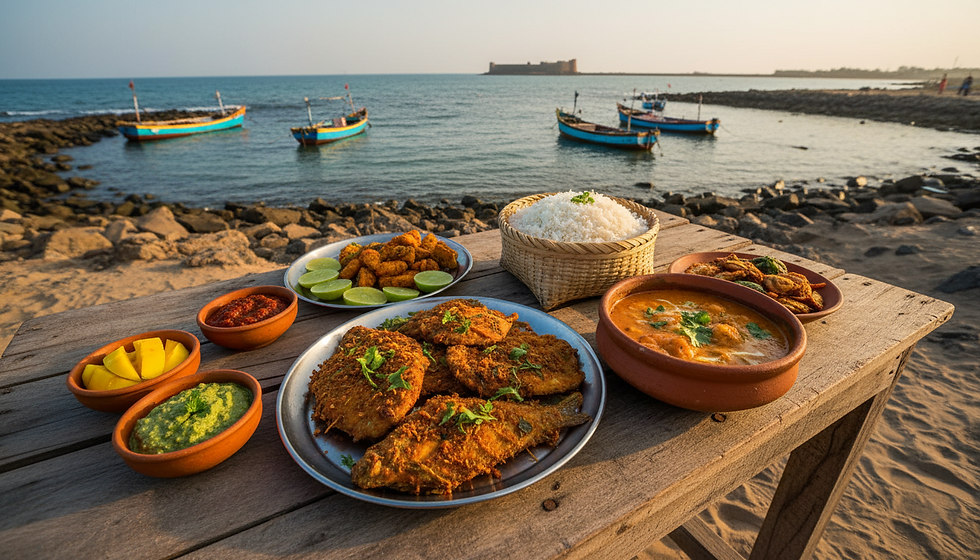
Pomfret fry is simple, crisp, and deeply coastal
Pomfret fry is one of the most loved dishes along this stretch of coast. The fish is usually cleaned, scored, rubbed with turmeric, chilli, ginger, garlic, salt, and sometimes a souring agent like lime or vinegar. It is then shallow-fried until the outside turns crisp while the flesh stays soft.
The charm lies in restraint. A good pomfret fry does not hide the fish. It supports it.
At a small eatery near a beach road, I once watched an elderly cook refuse to fry a fish twice for a customer who wanted it “extra crisp.” She smiled, shook her head, and said it would ruin the sweetness of the flesh. That kind of confidence comes from cooking the same dish for years. When the plate arrived, she was right. The edges crackled, but the centre was tender and clean-tasting.
Pomfret fry is best eaten with sliced onions, lime, green chutney, and soft pav or rice.
Prawn curry brings coconut, spice, and comfort together
Daman’s prawn curry often carries the warmth of coastal home cooking. Coconut gives it a mellow base. Chilli adds heat. Tamarind or vinegar gives it lift. The prawns cook quickly, so the gravy matters. It needs time to settle before the prawns go in.
Some versions are fiery and red. Others are gentler, with yellow turmeric tones and a softer coconut flavour. Rice is the natural partner. Pav works too, especially when the curry is thick enough to scoop.
One fisherman’s family described prawn curry as a “rainy day dish.” During monsoon months, when the sea feels heavy and the air smells of wet earth, a hot prawn curry with rice can feel like the centre of the day.
Crab masala is messy in the best way
Crab masala is not a polite dish. It asks you to use your hands, crack shells, stain your fingers, and slow down. The masala clings to the shell, often made with onion, tomato, garlic, chilli, and spices. Some versions use coconut. Others are drier and sharper.
This dish shows why coastal eating feels different from restaurant eating in big cities. The pleasure is not only in taste. It is in the work of getting to the meat, the shared laughter at the table, and the pile of shells that proves the meal was worth it.
Dishes in this image: Close-up of crispy pomfret fry with lime and onion on a steel plate

Image shows: Close-up of crispy pomfret fry with lime and onion on a steel plate.
Portuguese influence still lingers in spicy, tangy dishes
Daman was under Portuguese rule for centuries, and food is one area where that history remains easy to taste. The influence does not appear as a fixed museum-style cuisine. It shows up in dishes that use vinegar, chilli, garlic, and marinades with bold sour notes.
Prawn balchão carries a sharp and fiery legacy
Balchão is closely associated with Indo-Portuguese cooking along the western coast. In Daman, prawn balchão appears in some homes and local menus as a spicy, tangy preparation that can be eaten fresh or kept for a short time because of the vinegar-rich masala.
The flavour is intense. Dried red chilli, garlic, spices, and vinegar create a paste that coats the prawns. The result is hot, sour, slightly sweet from the prawns, and very good with plain rice or pav.
Balchão is not the mildest entry point into Daman food, but it is one of the most memorable. It tastes like history preserved in spice.
Chicken and meat dishes show another side of Daman
Although seafood gets most of the attention, Daman’s Catholic and Portuguese-influenced communities have also shaped meat dishes. Chicken cooked with vinegar, garlic, green masala, or red chilli paste appears in different forms. Some preparations resemble the broader Goan and western coastal style, but local families adjust them to their own tastes.
At a family meal, a host once explained that no two households make the same masala. One uses more vinegar, another more green chilli, another adds a little sweetness to calm the heat. Recipes travel through families, but they also change with memory. That is why the same dish can taste different from lane to lane.
Vindaloo-style preparations are for people who like bold flavours
Vindaloo-style cooking, with its vinegar-garlic-chilli base, is part of the wider Indo-Portuguese food story. In Daman, you may find local versions of tangy meat or seafood curries that follow this flavour path. They are usually rich, sharp, and warming, with a sour finish that makes you reach for more rice.
The dish’s roots connect to Portuguese marinated meat traditions, which adapted in India with local chillies, spices, and cooking habits. That adaptation is the real story. Daman did not simply receive a cuisine. It changed it.
Street food in Daman is where evenings come alive
By evening, Daman’s food mood shifts. The seafood lunches give way to snacks, tea, pav, chutney, and quick plates eaten standing near a stall. The street food scene reflects Gujarat strongly, but with coastal appetites and local twists.
Sev usal is spicy, crunchy, and filling
Sev usal is a popular Gujarati street-style dish made with a spicy curry of peas or pulses, topped with sev, onions, coriander, chutneys, and lime. In Daman, it makes an excellent evening snack after a beach walk.
The joy of sev usal is contrast. Hot curry meets crisp sev. Soft pulses meet raw onion. Chilli meets lime. It is affordable, fast, and full of texture.
A stall owner once joked that the correct amount of sev is “more than you planned.” He piled it high, then added more after the chutney went on. That extra handful made sense. The sev softened slowly into the curry while some stayed crisp on top.
Bhajiya and tea are a rainy day ritual
Bhajiyas are common across western India, but in Daman they feel especially right when the sea breeze turns cool. Onion, potato, chilli, or methi bhajiyas are dipped in gram flour batter and fried until golden. They arrive with chutney and sometimes fried green chillies.
Pair them with cutting chai and the snack becomes more than food. It becomes a pause. Locals often gather around tea stalls not just to eat, but to trade news, discuss the weather, and wait out a passing shower.
Pav bhaji and vada pav bring Mumbai-Gujarat comfort
Because Daman sits close to Gujarat and is connected culturally to western India, pav-based snacks are easy to find. Pav bhaji brings buttery mashed vegetables with soft bread. Vada pav brings a spiced potato fritter tucked into pav with chutney.
These may not be unique only to Daman, but they belong to its everyday food rhythm. Travellers looking for famous foods of Daman should not skip them, especially from busy stalls where the tava stays hot and the chutney is made fresh.
Dishes in this image: Eye-level view of a Daman street food vendor serving sev usal in a steel bowl

Image shows: Eye-level view of a Daman street food vendor serving sev usal in a steel bowl.
Vegetarian plates and sweets deserve attention too
Daman is not only for seafood lovers. Its Gujarati influence means vegetarian food is easy to find, satisfying, and often made with great care.
Dhokla and khaman are soft, light, and travel-friendly
Dhokla and khaman are common breakfast or snack choices. Made from fermented or gram flour-based batters, they are steamed, tempered with mustard seeds, curry leaves, and green chillies, and served with chutney.
The flavour is gentle, slightly sweet, tangy, and savoury at once. That balance is very Gujarati. It also makes these snacks ideal before a day of sightseeing.
Patra brings leafy richness and spice
Patra, made with colocasia leaves coated in spiced gram flour paste, rolled, steamed, sliced, and tempered, is another dish worth trying. It delivers sour, sweet, spicy, and nutty flavours in one bite.
It takes effort to make well. The leaves must be cleaned and layered, the paste spread evenly, and the rolls steamed properly. When done right, patra is soft, rich, and deeply satisfying.
Local thalis offer the best overview
A vegetarian thali in Daman may include rotli, dal, rice, shaak, farsan, pickle, papad, and a sweet. Some thalis lean Gujarati, with a mild sweetness in dal or vegetables. Others are simpler and more home-style.
For a traveller, a thali is useful because it offers range. You taste several small preparations in one meal and understand how daily food differs from festive seafood.
Sweet endings are simple and comforting
Daman does not need elaborate desserts to make a meal feel complete. Look for:
Sweet dish | What to expect | Best time to try it |
Shrikhand | Thick sweetened yoghurt flavoured with cardamom or saffron | After a Gujarati meal |
Basundi | Slow-cooked sweet milk, rich and creamy | As a festive dessert |
Kulfi | Dense frozen milk dessert, often with pistachio or malai | After an evening walk |
Jalebi | Crisp, syrupy spirals served hot | With fafda or as a morning treat |
These sweets connect Daman to Gujarat and the wider western Indian food tradition. They also balance the chilli and tang of the coastal dishes.
How to eat your way through Daman without missing the good stuff
The best food experiences in Daman are not always in polished restaurants. Many are in modest eateries, beachside shacks, family-run kitchens, and small stalls with loyal local customers.
Here is a simple way to plan a food day around the famous foods of Daman.
Morning
Start with khaman, dhokla, jalebi, or tea and snacks. If you prefer something heavier, try a local thali later in the morning.
Lunch
Choose seafood. Pomfret fry, prawn curry, crab masala, or a fish curry rice plate will give you the clearest taste of coastal Daman.
Evening
Walk near the seafront or market areas and look for snacks. Sev usal, bhajiya, pav bhaji, vada pav, and cutting chai are ideal.
Dinner
Go for a Portuguese-influenced dish if available, such as prawn balchão or a vinegar-rich chicken preparation. If not, a simple fish curry and rice will still do the job beautifully.
Tips for a better food trail
Ask what fish is fresh that day instead of ordering by habit.
Eat seafood at places with steady local footfall.
Try both coastal and Gujarati dishes to understand Daman fully.
Keep space for snacks. Daman’s evenings are made for grazing.
If a dish sounds too spicy, ask before ordering. Local masalas can be sharp.
Dishes in this image: Overhead view of a Daman vegetarian thali with farsan, dal, rice, rotli, and sweets

Image shows: Overhead view of a Daman vegetarian thali with farsan, dal, rice, rotli, and sweets.
A final taste of Daman
Daman’s food is memorable because it does not belong to only one tradition. It is coastal, Gujarati, Portuguese-influenced, homely, sharp, sweet, and comforting all at once. A plate of pomfret fry tells one story. Prawn balchão tells another. Sev usal by a street stall tells a third.
Together, they show a place shaped by the sea and by the people who kept cooking through change.
For food enthusiasts and travellers, the famous foods of Daman offer more than a checklist of dishes. They offer a way to notice the town more closely: the morning fish markets, the smell of frying batter during rain, the soft sweetness in a Gujarati dal, and the tang of vinegar in a family recipe passed down without exact measurements.
Come hungry, eat slowly, and let Daman reveal itself one plate at a time.
Travel, landmark, location, and shop information is based on publicly available online data at the time of writing. Details such as names, addresses, opening hours, availability, prices, and operating status may change. Please verify current details directly with the venue or official source before visiting.
Explore more city food guides
Continue exploring Indian food, landmarks and local markets: Pune · Surat · Srinagar · Leh · Port Blair


Comments