
famous foods of Agartala (Tripura) A Guide to Must Try Local Dishes

Agartala’s food is quiet at first glance, then bold on the plate. A meal here can bring together bamboo shoots, fermented fish, river fish, smoked meat, soft rice cakes, coconut sweets, and a fierce chilli chutney that wakes up every bite.
As the capital of Tripura, Agartala is one of the best places to taste the state’s mixed food culture. Indigenous Tripuri cooking sits alongside Bengali flavours, market snacks, tea-time sweets, and simple home-style meals built around rice. If you are looking for the famous foods of Agartala (Tripura), start with dishes that locals eat with rice, not just the snacks that appear on tourist lists.
This guide walks through the must-try local dishes, what they taste like, and how to enjoy them without feeling lost at the table.
Dishes in this image: Wide-angle view of a Tripuri meal served on banana leaves with rice, bamboo shoot curry, fish, chutney, and greens
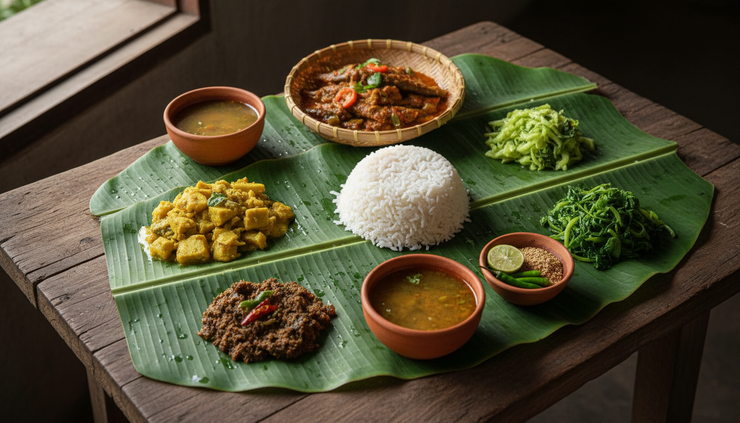
Image shows: Wide-angle view of a Tripuri meal served on banana leaves with rice, bamboo shoot curry, fish, chutney, and greens.
Agartala’s food is shaped by rice, bamboo shoots, fish, and chilli
Tripuri cuisine is deeply tied to local produce. Rice is the centre of most meals. Around it come vegetables, herbs, bamboo shoots, pulses, fish, meat, and chutneys. Many dishes use little oil, which gives the food a clean, earthy taste.
One ingredient stands out: berma, a fermented fish preparation used in many traditional dishes. It has a strong smell, but it adds depth and savoury flavour when cooked well. Think of it as a seasoning base rather than a dish by itself.
Bamboo shoots are just as important. They bring a light sourness and crunch that works well with pork, chicken, fish, and vegetables. Chilli also plays a big role, often in chutneys rather than curry gravies.
Agartala’s food is not only Tripuri. Because of the city’s strong Bengali influence, you will also find fish curries, rice meals, sweets, cutlets, chops, and tea snacks across homes, markets, and small eateries.
A good food plan in Agartala should include both sides:
Traditional Tripuri dishes built around rice, berma, bamboo shoots, and smoked or boiled flavours
Bengali-style fish, sweets, and snacks that are part of the city’s everyday food culture
Traditional Tripuri dishes to try in Agartala
The best Tripuri food is often modest in appearance. It does not rely on heavy cream, thick masala, or too much frying. The flavour comes from fermentation, vegetables, smoke, herbs, and chilli.
Gudok is the comfort dish every food lover should know
Gudok is one of Tripura’s most loved traditional dishes. It is a thick, rustic preparation made with vegetables, berma, and sometimes dry fish or local greens. Different families make it differently, so the taste can change from mild and earthy to sharp and intense.
Common ingredients may include:
Green papaya
Bamboo shoots
Jackfruit seeds
Potatoes
Beans
Local greens
Fermented fish
Gudok is usually eaten with steamed rice. It is not a polished restaurant-style curry. It feels more like a home dish, warm, filling, and full of local character.
If you are new to berma, Gudok is a good starting point because the vegetables soften the strong fermented flavour.
Chakhwi brings together bamboo shoots and gentle heat
Chakhwi is another important Tripuri dish. It is often made with bamboo shoots, green papaya, vegetables, and sometimes pork or chicken. A key feature is its alkaline taste, traditionally created with a local ingredient known as khar or alkaline water.
The result is light but distinct. Chakhwi does not taste like a North Indian curry. It has a clean broth-like body, mild sourness from bamboo shoots, and a soft savoury finish.
Chakhwi works best with plain rice because the rice balances the sharp and earthy notes. If you enjoy food that feels simple but carries a deep local identity, this is a must-try.
Muya Awandru is a bamboo shoot dish with a strong local soul
Muya Awandru is made with bamboo shoots, rice flour, and berma. The rice flour gives it a soft thickness, while the bamboo shoots add texture and tang. Berma gives it the savoury base that marks many traditional Tripuri dishes.
It is a dish for people who enjoy regional flavours that do not taste generic. The aroma can be strong for first-time eaters, but the balance of rice, bamboo shoots, and fermented fish makes it deeply satisfying.
Order it with steamed rice and a small chutney on the side. That is enough for a memorable meal.
Dishes in this image: Close-up of bamboo shoot curry in a clay bowl with steamed rice and green chillies beside it

Image shows: Close-up of bamboo shoot curry in a clay bowl with steamed rice and green chillies beside it.
Kosoi Bwtwi keeps beans simple and flavourful
Kosoi Bwtwi is a beans-based dish often cooked with berma. Like many Tripuri foods, it uses simple ingredients and lets them speak clearly. The beans keep their fresh, green flavour, while the fermented fish adds saltiness and depth.
It is a good dish to try when you want something lighter than pork or fish curry. It also pairs well with other items on a thali-style plate.
Mosdeng Serma is the chutney that changes the whole meal
Mosdeng Serma is a fiery chutney made with roasted or boiled tomatoes, chillies, garlic, onion, and sometimes berma. It is not a side dish you ignore. A small spoonful can change the taste of a full plate of rice.
The flavour is smoky, hot, tangy, and sharp. It goes well with rice, boiled vegetables, meat, fish, and even simple dal.
If you are sensitive to chilli, taste a little first. Local versions can be much hotter than they look.
Meat and fish dishes bring out Agartala’s bold side
Agartala’s food has plenty for meat and fish lovers. Pork is widely used in many indigenous Tripuri dishes, while fish is central to Bengali-style meals in the city. The result is a food scene where a rice plate can go in many directions.
Wahan Mosdeng is a must for pork lovers
Wahan Mosdeng is one of the most talked-about pork dishes from Tripura. “Wahan” refers to pork, while “mosdeng” points to a chutney-like preparation. The dish often brings together boiled or roasted pork with chillies, onion, ginger, and local aromatics.
It is not usually a heavy curry. The focus stays on the pork and the heat of the chilli mix. Some versions are smoky, some are sharp, and some are rich from pork fat.
Eat it with hot rice. That simple pairing gives the dish its full meaning.
Smoked pork with bamboo shoots is rich, tangy, and satisfying
Smoked pork and bamboo shoots are a natural match. The pork brings fat and depth. The bamboo shoots cut through that richness with a sour crunch. The smoke adds another layer without needing too many spices.
This dish is common across several parts of North East India, and Tripura has its own style of preparing it. In Agartala, it may appear in local eateries that serve tribal or regional food.
If you prefer strong flavours, this is one of the best dishes to order.
River fish curry shows the Bengali side of Agartala
Fish is a daily comfort food for many families in Agartala. Bengali-style fish curry, often eaten with rice, is easy to find in homes and local restaurants. The curry can be light and soupy or richer with mustard, spices, and vegetables.
Common fish preparations may include:
Rohu curry with rice
Fish cooked with mustard
Small fish with vegetables
Dry fish chutney or side dishes
These dishes may not feel rare, but they are central to how the city eats. A simple fish-and-rice lunch in Agartala can be just as memorable as a more unusual traditional dish.
Dishes in this image: Eye-level view of smoked pork with bamboo shoots served in a black bowl with rice and herbs

Image shows: Eye-level view of smoked pork with bamboo shoots served in a black bowl with rice and herbs.
Snacks, sweets, and market foods complete the experience
Agartala’s food story is not limited to main meals. Tea stalls, sweet shops, markets, and roadside vendors add another layer. These foods are easy to try during a walk through the city.
Bangwi is a rice cake wrapped with care
Bangwi is a traditional Tripuri rice cake, usually wrapped in leaves and steamed. It is made with rice and can include coconut, ghee, or other simple fillings depending on the version.
The leaf wrapping gives it aroma, while steaming keeps the texture soft. It is often linked with festivals and special occasions, but you may also find it through local food sellers or during cultural events.
Bangwi is gentle compared to the strong flavours of berma-based dishes. Try it when you want to taste the rice-based side of Tripuri food.
Pitha adds sweetness to the local table
Pitha is common across Bengal and parts of North East India, and Agartala has its share of versions. These rice-based sweets or snacks may be steamed, fried, or pan-cooked. Fillings often include coconut and jaggery.
During winter and festivals, pitha becomes more visible. It tastes best fresh, especially with tea.
Look for soft, coconut-filled pitha if you enjoy mild sweetness rather than syrup-heavy desserts.
Bengali sweets are part of Agartala’s everyday food culture
Sweet shops in Agartala often carry familiar Bengali favourites. After a local meal, a small sweet can be the perfect finish.
Popular choices include:
Rosogolla
Sandesh
Mishti doi
Chomchom
Chhanar sweets
These sweets are not unique only to Tripura, but they are part of Agartala’s daily food rhythm. Many people buy them for guests, festivals, family visits, and evening treats.
Chops, cutlets, and tea snacks are easy street-side bites
For a quick bite, look for vegetable chops, fish cutlets, egg rolls, pakoras, and samosas. These snacks reflect Agartala’s Bengali influence and work well with a cup of milk tea.
They are not the most traditional Tripuri dishes, but they show how the city eats between meals. If you are exploring markets, these snacks are often the easiest way to keep going.
How to eat your way through Agartala without missing the real flavours
The best way to enjoy Agartala’s food is to mix curiosity with patience. Some dishes may taste unfamiliar at first, especially those made with berma or bamboo shoots. Give them time. Try them with rice, not alone, because that is how they are meant to be eaten.
A simple food plan could look like this:
Time of day | What to try | Why it works |
Breakfast | Pitha, tea, or light snacks | A gentle start with local and Bengali influences |
Lunch | Rice with Gudok, Chakhwi, fish curry, and Mosdeng Serma | The best time for a full traditional meal |
Evening | Chops, cutlets, sweets, and tea | Easy market-style eating |
Dinner | Wahan Mosdeng or smoked pork with bamboo shoots | A bold way to end the day |
When ordering, ask whether a dish contains berma, pork, or dry fish if you have dietary preferences. Many traditional foods use these ingredients even when they are not obvious from the name.
If you do not eat pork, choose vegetable-based Tripuri dishes, fish curry, rice cakes, chutneys, and sweets. If you do not eat fish, check carefully before ordering Gudok, Muya Awandru, or Kosoi Bwtwi because berma is often used as a flavour base.
A few useful tips:
Start with a thali-style meal if available, as it lets you taste several dishes in small portions.
Pair strong dishes with plain rice to balance salt, heat, and fermented flavours.
Ask for chilli levels before trying Mosdeng Serma or pork chutneys.
Try local sweets fresh rather than packaged versions.
Do not judge berma by smell alone. Its flavour becomes more balanced when cooked into a dish.
Dishes in this image: Top-down view of rice pitha and Bengali sweets arranged on a brass plate with tea

Image shows: Top-down view of rice pitha and Bengali sweets arranged on a brass plate with tea.
The dishes that best define Agartala’s local food
If you only have time for a few plates, focus on the dishes that show the city’s range. A strong short list would include Gudok, Chakhwi, Muya Awandru, Wahan Mosdeng, Mosdeng Serma, fish curry with rice, Bangwi, and fresh pitha.
These dishes cover the main flavours of Agartala: fermented, smoky, sour, spicy, sweet, and comforting. They also show the blend that makes the city’s food special. Indigenous Tripuri cooking brings bamboo shoots, berma, pork, rice, and chilli to the table. Bengali food adds fish curries, sweets, fried snacks, and tea-time comfort.
The famous foods of Agartala (Tripura) are not about one signature dish alone. They are about the way rice holds the meal together, the way chutney adds fire, the way bamboo shoots brighten a curry, and the way sweets end even a simple lunch on a happy note. Try the local dishes slowly, ask questions, and leave space for flavours that may be new. That is the most rewarding way to eat in Agartala.
Travel, landmark, location, and shop information is based on publicly available online data at the time of writing. Details such as names, addresses, opening hours, availability, prices, and operating status may change. Please verify current details directly with the venue or official source before visiting.
Explore more city food guides
Continue exploring Indian food, landmarks and local markets: Pune · Surat · Srinagar · Leh · Port Blair


Comments