
Taste of Patiala Traditional Foods Recipes and Polls for Your Favorite Dish

Patiala does not serve food quietly. It arrives with the smell of ghee, the heat of hand-ground spices, the comfort of slow cooking, and the warmth of Punjabi hospitality. A meal here is rarely just a plate of food. It is a family story, a seasonal habit, a royal influence, and often, a reason to sit a little longer.
The city’s cuisine reflects its past as a princely centre of Punjab, shaped by courtly kitchens, farming traditions, dairy-rich homes, and the everyday generosity of Punjabi dining. From creamy gravies to smoky tandoori bites, from winter saag to festive sweets, the food of Patiala carries both richness and memory.
This guide explores the Famous food of Patiala through traditional dishes, key ingredients, cooking methods, and a few simple poll prompts so every reader can join the conversation.
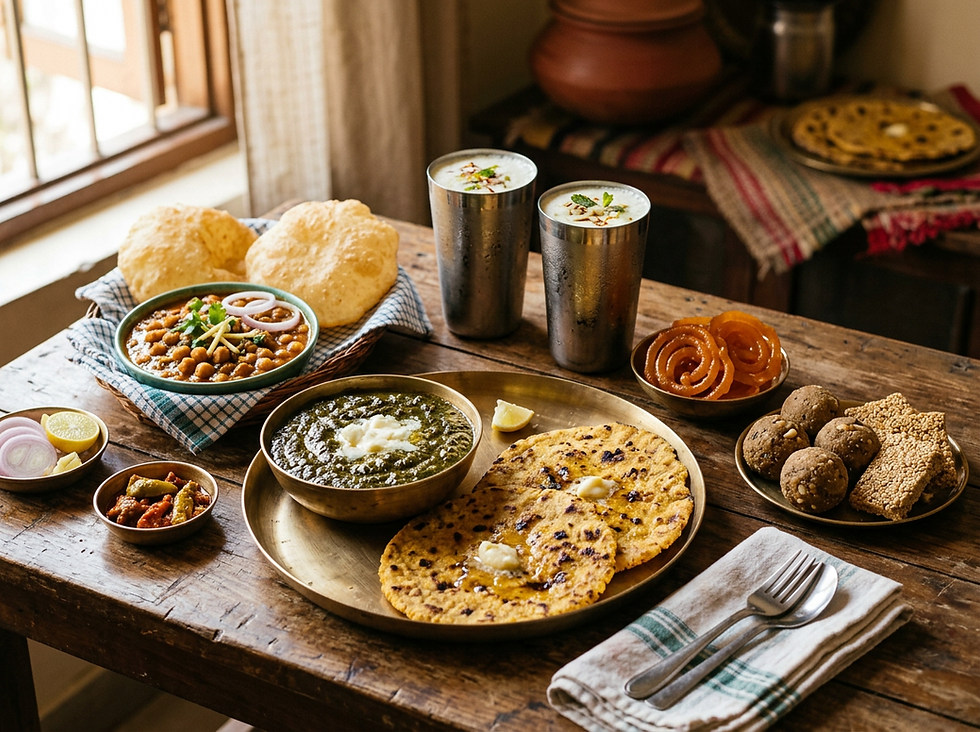
Dishes in this image: Wide-angle view of a traditional Patiala meal served on a brass thali

Image shows: Wide-angle view of a traditional Patiala meal served on a brass thali.
Patiala’s food carries the flavour of history
Patiala’s food culture grew from two strong roots. One came from the royal kitchens of the Patiala state, where cooks prepared rich meat dishes, fragrant gravies, and elaborate meals for the court. The other came from Punjab’s agrarian life, where wheat, maize, mustard greens, milk, butter, curd, and lentils formed the heart of daily cooking.
That mix explains why Patiala food feels both grand and grounded. A chicken curry may carry the depth of a royal recipe, while a bowl of saag still tastes like a winter afternoon in a Punjabi home.
Common flavours include:
Ghee and white butter for richness
Curd and cream for body in gravies
Ginger, garlic, onion, and green chillies as the base of many dishes
Kasuri methi, garam masala, cumin, coriander, and red chilli for warmth
Tandoor smoke for breads, kebabs, and roasted snacks
Jaggery, nuts, and atta in winter sweets
The cooking style values patience. Meat rests in marinades. Gravies simmer until the oil separates. Saag cooks slowly until the greens soften fully. Even simple parathas gain character when they meet a hot tawa, ghee, and a spoonful of pickle.
Signature savoury dishes from Patiala deserve a closer look
Patiala’s most loved dishes are hearty, deeply flavoured, and built for sharing. They often use familiar ingredients, but their magic lies in technique.
Patiala shahi chicken is rich, creamy, and full of spice
Patiala shahi chicken is one of the dishes most closely associated with the city’s royal food tradition. It is not a light curry. It is meant to feel festive.
The dish usually begins with chicken marinated in curd, ginger-garlic paste, salt, red chilli, turmeric, and sometimes a little lemon juice. The curd tenderises the meat and helps the spices cling to it.
The gravy often includes:
Onions browned slowly
Tomato puree or chopped tomatoes
Cashew paste or melon seed paste
Cream or malai
Garam masala
Kasuri methi
Ghee or mustard oil
The cooking method matters. Onions must brown without burning. The masala cooks until it turns glossy and releases fat around the edges. The marinated chicken then simmers in this base until tender. Cream goes in near the end, giving the curry its soft, royal finish.
A good Patiala-style chicken curry tastes layered. First comes heat, then sweetness from onions, then the richness of dairy, then the perfume of dried fenugreek.
Mutton curry shows the slow-cooked side of Patiala
Punjabi mutton curry has a strong place in celebratory meals. In Patiala, it often leans towards bold spices and slow cooking.
The usual ingredients include mutton with bone, onions, curd, ginger-garlic paste, whole spices, coriander powder, chilli powder, turmeric, and garam masala. Bone-in meat adds depth to the gravy.
The traditional method is simple but unhurried. The meat is first seared with spices, then cooked with onion masala until the gravy darkens. Water is added in stages, and the curry simmers until the meat turns soft.
Some homes prefer a pressure cooker for ease. Others swear by slow cooking in a heavy-bottomed vessel. Both methods can work, but the key is allowing the masala to coat the meat properly before adding too much liquid.
Paneer tikka brings the tandoor to the table
Paneer tikka is not only a restaurant favourite. It also reflects Punjab’s love for dairy and fire.
Large cubes of paneer are marinated in thick curd, besan, ginger-garlic paste, ajwain, red chilli, turmeric, garam masala, chaat masala, mustard oil, and lemon juice. Capsicum, onion, and tomato often share the skewers.
Traditionally, the skewers cook in a tandoor. At home, a hot oven, grill pan, or tawa can deliver a satisfying version. The aim is clear: charred edges, soft paneer, and a smoky aroma.
For a Patiala-style touch, brush the tikka with ghee just before serving and finish with a sprinkle of chaat masala.
Dishes in this image: Close-up view of paneer tikka skewers charring over a clay tandoor
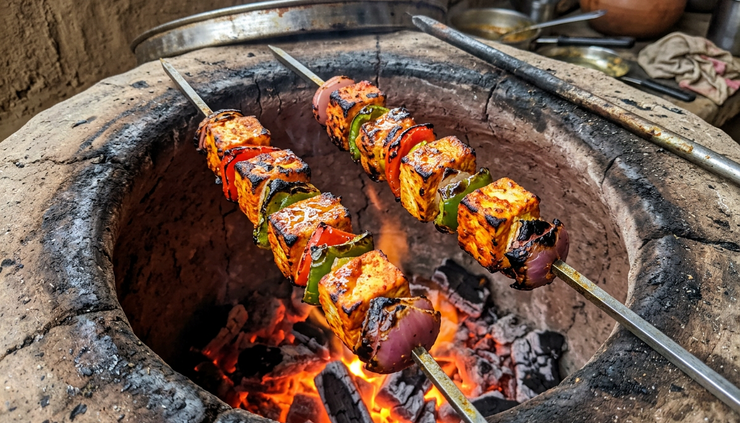
Image shows: Close-up view of paneer tikka skewers charring over a clay tandoor.
Everyday favourites are just as important as royal dishes
The Famous food of Patiala is not limited to rich curries. Some of the city’s most loved foods come from daily kitchens, winter mornings, street stalls, and family gatherings.
Dish | Main ingredients | Cooking method | Best served with |
Sarson da saag | Mustard greens, spinach, bathua, maize flour, ginger, garlic | Slow-cooked, mashed, tempered with ghee | Makki di roti, white butter, jaggery |
Chole bhature | Chickpeas, tea or amla for colour, spices, refined flour dough | Chickpeas simmered in masala, bhature deep-fried | Onion, pickle, green chutney |
Stuffed paratha | Wheat flour, potato, paneer, gobhi, radish, spices | Rolled and roasted on tawa with ghee | Curd, butter, pickle |
Punjabi kadhi pakora | Besan, curd, onion pakoras, spices | Simmered slowly, finished with tempering | Steamed rice |
Lassi | Curd, water or milk, sugar or salt | Churned until frothy | Breakfast, parathas, spicy meals |
Sarson da saag and makki di roti define Punjabi winter
Few dishes carry the season as beautifully as sarson da saag. Mustard greens form the base, but many homes add spinach and bathua to balance the sharpness. The greens are washed well, chopped, and cooked with green chillies, ginger, and garlic until soft.
Once cooked, the greens are mashed. Some families use a wooden mathani. Others use a hand blender, though many still prefer a coarse texture. Maize flour is added to thicken the saag.
The tempering makes it shine. Ghee, garlic, onion, and sometimes dried red chilli are fried and poured over the greens. Served with makki di roti, white butter, and jaggery, it becomes a complete winter ritual.
Chole bhature brings street-style joy
Patiala’s chole bhature follows the broader Punjabi love for bold chickpea curry and puffed fried bread. The chickpeas are soaked overnight, then cooked with whole spices. Many cooks add tea leaves tied in a cloth or dried amla to deepen the colour.
The masala uses onion, tomato, ginger, garlic, cumin, coriander, chilli, anardana, and chole masala. The curry should be thick enough to cling to the bhature.
Bhature dough is made with maida, curd, salt, and a little baking agent or fermentation time. When fried well, it puffs dramatically and stays soft inside.
This is weekend food, market food, and comfort food at once.
Stuffed parathas keep breakfast generous
A Patiala breakfast can be wonderfully direct: hot parathas, curd, pickle, and butter. Fillings vary by season and mood.
Popular fillings include:
Spiced potato with coriander and green chilli
Grated radish with ajwain
Cauliflower with ginger and garam masala
Paneer with onion and black pepper
Leftover dal mixed into dough
The trick is to keep the filling dry enough to roll. The paratha is cooked on a hot tawa, first dry, then with ghee until brown spots appear on both sides.
Dishes in this image: Eye-level view of stuffed parathas with butter, curd, and mango pickle
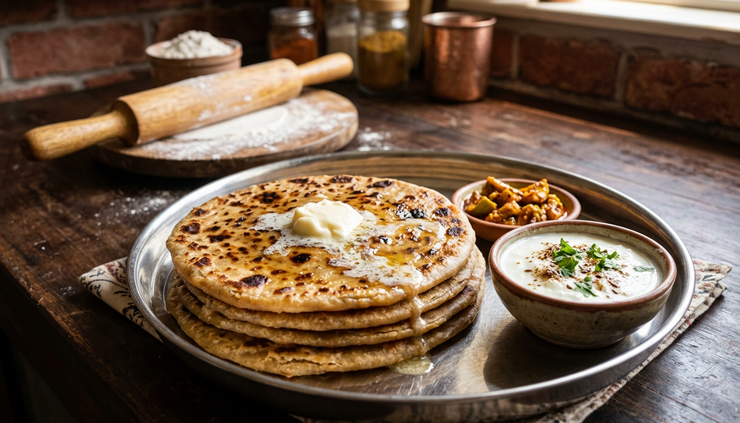
Image shows: Eye-level view of stuffed parathas with butter, curd, and mango pickle.
Sweet dishes and drinks complete the Patiala meal
Patiala’s food culture also has a sweet and cooling side. These dishes often appear during festivals, weddings, winter evenings, and family visits.
Pinni is a winter sweet with strength and warmth
Pinni is made with atta, ghee, sugar or jaggery, nuts, and sometimes edible gum. The flour is roasted slowly in ghee until it turns aromatic and golden. This step cannot be rushed. If the flour stays under-roasted, the pinni tastes raw. If it burns, the bitterness stays.
Once the mixture cools slightly, powdered sugar or jaggery is added with almonds, cashews, and cardamom. The mixture is shaped into round laddoo-like portions.
Many Punjabi families have their own version. Some add desi ghee generously. Some use gond for winter warmth. Some keep it simple with atta, sugar, and nuts.
Jalebi with rabri makes celebrations sweeter
Crisp jalebi dipped in sugar syrup is loved across North India, and Patiala is no exception. The batter is usually made with maida and fermented until slightly tangy. It is piped into hot oil in spirals, fried crisp, and soaked in warm sugar syrup flavoured with cardamom or saffron.
With rabri, it becomes richer. The thickened milk softens the sharp sweetness of jalebi and turns it into a festive dessert.
Lassi is the drink that cools the spice
Patiala’s meals often end, or begin, with lassi. Sweet lassi uses curd, sugar, and sometimes malai. Salted lassi may include roasted cumin and black salt.
The best lassi has body. It should feel creamy but not heavy, frothy but not thin. In many homes, it is still made by churning curd by hand.
A tall glass of lassi balances spicy chole, parathas, and tandoori snacks. It also reflects Punjab’s deep dairy culture.
Try these Patiala food polls and share your family recipes
Food becomes more meaningful when people add their own memories. A curry may remind someone of a wedding. A paratha may bring back a grandparent’s kitchen. Saag may recall winter Sundays when everyone ate together.
Use these quick polls as conversation starters. If this post appears on a blog or community page, these can be turned into clickable options.
Poll one
Which Patiala dish would you choose for a Sunday lunch?
[ ] Patiala shahi chicken
[ ] Sarson da saag with makki di roti
[ ] Chole bhature
[ ] Stuffed paratha with curd
[ ] Punjabi kadhi chawal
Poll two
What makes a dish taste truly Patiala to you?
[ ] Extra ghee and butter
[ ] Slow-cooked masala
[ ] Tandoor smoke
[ ] Fresh dairy
[ ] Family-style serving
Poll three
Which sweet should finish a Patiala meal?
[ ] Pinni
[ ] Jalebi with rabri
[ ] Kheer
[ ] Gajar ka halwa
[ ] Sweet lassi
Have a family recipe for mutton curry, saag, pinni, or paratha filling? Share the story behind it. Mention who taught it, what makes it different, and which ingredient cannot be skipped. These small details keep food traditions alive.
Dishes in this image: Overhead view of pinni, jalebi, and lassi arranged on a wooden table
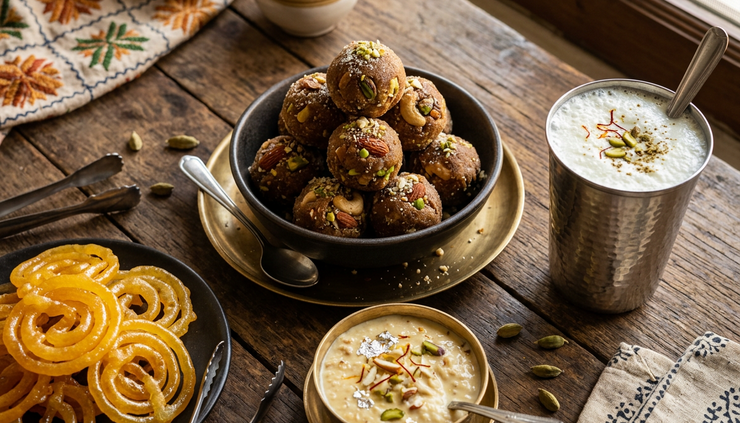
Image shows: Overhead view of pinni, jalebi, and lassi arranged on a wooden table.
How to bring Patiala flavours into your own kitchen
A Patiala-style meal does not need restaurant equipment. It needs good ingredients, patience, and respect for the basics.
Start with these habits:
Use fresh ginger, garlic, and green chillies instead of relying only on powders.
Brown onions slowly for gravies.
Let curd-based marinades rest before cooking.
Cook masala until the raw smell disappears.
Finish rich dishes with kasuri methi, ghee, or cream in small amounts.
Serve food hot, with pickle, onion, curd, and fresh roti.
For a simple Patiala-inspired menu, try this combination:
Meal occasion | Suggested menu |
Winter lunch | Sarson da saag, makki di roti, white butter, jaggery, lassi |
Family dinner | Patiala shahi chicken, tandoori roti, salad, jalebi |
Weekend breakfast | Aloo paratha, curd, mango pickle, sweet lassi |
Festive spread | Paneer tikka, mutton curry, naan, pinni, rabri |
The charm lies in balance. Rich curries taste better with sliced onions and lemon. Fried bhature need spicy chole. Saag needs butter, but also jaggery on the side. Lassi cools the meal and rounds it off.
Patiala’s cuisine reminds us that food is not only cooked, it is inherited. Its dishes carry royal polish, village wisdom, seasonal rhythms, and family pride. The next time a plate of saag, chicken curry, paratha, or pinni reaches the table, ask for the story behind it. That story may be the most memorable flavour of all.
Explore more city food guides
Continue exploring Indian food, landmarks and local markets: Pune · Surat · Srinagar · Leh · Port Blair


Comments