
Famous Foods of Kochi History Culture and Must Try Local Delights

Kochi tastes like a port city. Coconut, black pepper, curry leaves, rice, seafood, banana, beef, appam, stew, and spice come together in ways that tell a long story of trade, migration, faith, and local craft.
Set on Kerala’s coast, Kochi has welcomed Arab traders, Chinese fishing traditions, Jewish communities, Portuguese influence, Dutch contact, British colonial rule, and people from across Kerala. Food here did not grow in isolation. It absorbed, adapted, and made everything local.
That is why the famous foods of Kochi are more than dishes to tick off a travel list. They show how the city eats at home, celebrates festivals, feeds workers near the harbour, and serves visitors who arrive hungry after walking through Fort Kochi, Mattancherry, Broadway, and Marine Drive.
Dishes in this image: Wide-angle view of a traditional Kochi meal with seafood curry, appam, rice and banana leaf sides

Image shows: Wide-angle view of a traditional Kochi meal with seafood curry, appam, rice and banana leaf sides.
Kochi’s food history began with spice, sea and settlement
Kochi’s place on the Malabar Coast shaped its kitchen. For centuries, Kerala’s spices drew traders from across the Indian Ocean. Black pepper, cardamom, cinnamon, cloves, and dried ginger moved through ports, and with them came ingredients, cooking methods, and eating habits.
The city’s food carries many layers.
Arab trade helped deepen Kerala’s connection with rice, meat dishes, dried fruits, and rich gravies. The Portuguese brought new ingredients to Indian kitchens, including chillies, tomato, and cashew, which later became common across Kerala. Chinese fishing nets became one of Kochi’s most recognisable sights, and the city’s seafood culture grew around fresh catch from the backwaters and the Arabian Sea.
Kochi also has strong Christian, Muslim, Hindu, and Jewish food traditions. Syrian Christian cooking is known for appam, stew, meat roasts, and coconut milk gravies. Moplah influence from Kerala’s northern coast shares a love for layered rice dishes, snacks, and spiced meat preparations. Vegetarian temple-style meals, sadya, and everyday coconut-based dishes remain central to many homes.
The result is food that feels both coastal and cosmopolitan. Kochi’s food is not flashy. It is fragrant, practical, and deeply tied to place.
A few ingredients appear again and again:
Coconut
Used as milk, grated coconut, oil, and roasted paste.
Black pepper
Once the pride of the Malabar trade, still essential in roasts and stews.
Curry leaves
Fried in coconut oil to give many dishes their unmistakable Kerala aroma.
Rice
Served as steamed rice, appam, puttu, idiyappam, pathiri, and more.
Seafood
Cooked fresh, fried crisp, or simmered in sour, spicy gravies.
The must try local dishes that define Kochi
Kochi offers everything from home-style food to street snacks and toddy shop favourites. These dishes give the best feel for the city’s table.
Appam with stew is soft, mild and deeply comforting
Appam is one of Kochi’s most loved breakfast and dinner dishes. It has a lacy, crisp edge and a soft, spongy centre. Made with fermented rice batter and coconut, it pairs beautifully with stew.
Vegetable stew usually has potatoes, carrots, beans, coconut milk, curry leaves, cinnamon, cloves, and black pepper. Chicken or mutton stew adds richer flavour but keeps the gravy gentle. The dish is common in Syrian Christian households and is often served during Sunday breakfasts, weddings, and Christmas meals.
The cultural beauty of appam and stew lies in its balance. The appam is local, rice-based, and coconut-rich. The stew carries spice trade notes, but it remains mild enough to let coconut milk lead.
Kerala fish curry brings the coast to the plate
Fish curry is essential to Kochi cuisine. Every home and small eatery may make it a little differently. Some versions use coconut milk. Others use ground coconut. Many include kudampuli, also known as Malabar tamarind, which gives a smoky sourness that cuts through the richness of fish.
The curry often uses seer fish, sardines, pearl spot, mackerel, or whatever is fresh that day. Red chilli powder, turmeric, shallots, ginger, garlic, curry leaves, and coconut oil add depth.
Kochi’s fish curry tells the story of local geography. The backwaters, fishing harbours, and coastal markets keep seafood central to daily meals. It is not treated as a luxury alone. For many families, fish with rice is everyday food.
Karimeen pollichathu is a backwater classic
Karimeen, or pearl spot, is one of Kerala’s prized fish. In karimeen pollichathu, the fish is marinated, lightly fried, coated with a masala of shallots, tomatoes, spices, and curry leaves, then wrapped in banana leaf and cooked.
The banana leaf does more than hold the fish. It traps steam and lends a gentle earthy aroma. The masala clings to the fish, and the result is smoky, spicy, sour, and rich.
This dish is strongly linked to Kerala’s backwater belt. Around Kochi, it often appears in seafood restaurants and homely meals near the water. It is one of the most photographed dishes too, but it deserves attention for its cooking technique, not just its appearance.
Dishes in this image: Close-up of karimeen pollichathu wrapped in banana leaf with spicy masala and curry leaves
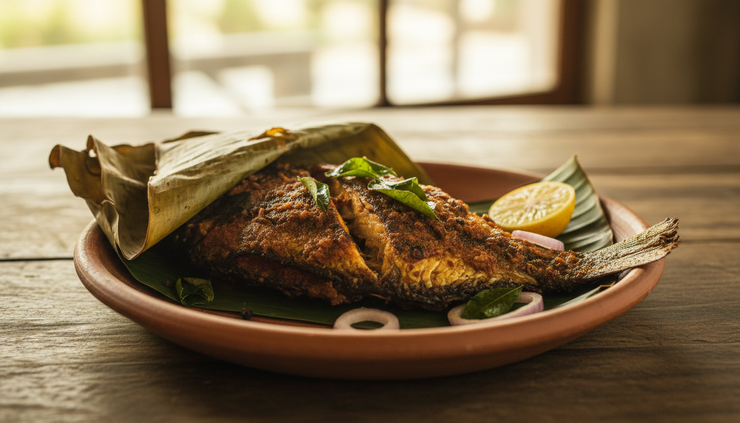
Image shows: Close-up of karimeen pollichathu wrapped in banana leaf with spicy masala and curry leaves.
Puttu and kadala curry make a filling Kerala breakfast
Puttu is steamed rice flour layered with grated coconut, shaped in a cylindrical mould. It is light, crumbly, and mildly sweet from the coconut. Kadala curry, made with black chickpeas, roasted coconut, spices, and curry leaves, gives it body and warmth.
This pairing shows Kerala’s practical side. It uses rice and coconut, the region’s staples, and turns them into a filling breakfast. In Kochi, puttu may also be served with banana, papad, fish curry, or meat curry.
Puttu has an old-fashioned charm, but it is not just nostalgia. It remains one of the best ways to start a day of walking through the city.
Beef fry reflects Kerala’s spice-loving side
Kerala-style beef fry is bold and peppery. Small pieces of beef are cooked with shallots, ginger, garlic, coconut slices, curry leaves, garam masala, turmeric, chilli, and plenty of black pepper. The dish is usually slow-fried until dark, dry, and intensely flavoured.
In Kochi, beef fry is often eaten with porotta, appam, puttu, or rice. It is especially popular in local eateries and toddy shops. Syrian Christian kitchens helped shape many beef and meat roast traditions in Kerala, and Kochi’s versions often carry that strong coconut oil and pepper character.
The dish also points to Kerala’s social diversity. Food habits differ across communities, but Kochi’s public eating culture makes room for many plates at the same table.
Kerala porotta with curry is street-side satisfaction
Kerala porotta is flaky, layered, and slightly chewy. It is made with refined flour dough, stretched thin, coiled, rolled, and cooked on a hot griddle. The layers soak up gravy beautifully.
In Kochi, porotta often comes with beef curry, chicken curry, egg roast, vegetable kurma, or kadala curry. It is a favourite in small restaurants, tea shops, and late evening food spots.
Porotta is not ancient in the same way rice-based foods are, but it has become part of Kerala’s modern food identity. It suits the working city, quick, filling, affordable, and satisfying.
Kochi’s snacks, sweets and tea-time favourites
A Kochi food walk feels incomplete without tea and snacks. Kerala’s chaaya kada culture, or tea shop culture, gives the city some of its most memorable bites.
Pazham pori is simple and loved everywhere
Pazham pori, also called ethakka appam, is ripe banana fritter. Slices of nendran banana are dipped in batter and fried until golden. The outside turns crisp, while the banana inside becomes soft and sweet.
It is best with hot tea. You will find it in tea shops, railway canteens, roadside stalls, and homes. Its popularity comes from its simplicity. Kerala grows excellent bananas, and the dish turns a common fruit into a snack with comfort value.
Unniyappam brings temple and home flavours together
Unniyappam is a small, round, fried sweet made with rice flour, jaggery, banana, coconut bits, and cardamom. It has a caramel-like crust and a soft centre.
The sweet is linked with Kerala homes and temple offerings. Around Kochi, it appears during festivals, family gatherings, and as a snack in bakeries. It carries the flavour of jaggery and coconut without feeling heavy.
Kozhukatta shows the quiet side of Kerala sweets
Kozhukatta is a steamed rice dumpling, often filled with coconut and jaggery. It is soft, mild, and soothing. Some versions are plain and savoury, while sweet ones are more common as a snack or festival food.
This dish shows how much Kerala cooking values steaming. Not every beloved food is fried or heavily spiced. Some are gentle, built around texture and aroma.
Banana chips are Kochi’s classic takeaway snack
Kerala banana chips are thin, crisp slices of raw banana fried in coconut oil. Some are salted. Some are coated with jaggery and spices, known as sharkara varatti.
They are common during Onam sadya and also popular as travel snacks. In Kochi’s markets, banana chips are often fried fresh, and the coconut oil aroma makes them hard to resist.
Dishes in this image: Eye-level view of banana chips, pazham pori and tea arranged inside a Kerala tea shop

Image shows: Eye-level view of banana chips, pazham pori and tea arranged inside a Kerala tea shop.
The cultural meals that show Kochi at its best
Some foods in Kochi are not just single dishes. They are experiences built around season, faith, and community.
Sadya celebrates abundance on a banana leaf
Sadya is Kerala’s grand vegetarian meal, usually served on a banana leaf. It is most closely linked with Onam, weddings, and major celebrations. A sadya can include rice, parippu, sambar, avial, olan, kaalan, thoran, pachadi, kichadi, pickles, papad, banana chips, sharkara varatti, rasam, buttermilk, and payasam.
The order of serving matters. The placement on the leaf matters. The balance of sweet, sour, salty, spicy, bitter, and mild flavours matters.
In Kochi, sadya connects people across communities because Onam itself has wide cultural reach in Kerala. It is a meal of generosity, memory, and rhythm. Eating it by hand also changes the experience. The rice, curries, ghee, and pickles mix in a way no spoon can copy.
Christmas and Easter meals carry Syrian Christian roots
Kochi has a strong Christian food culture. Around Christmas and Easter, homes may prepare appam, stew, duck roast, beef roast, cutlets, plum cake, and wine. The food often blends Kerala spices with festive meat cooking.
Plum cake is now common in bakeries across Kerala, especially in December. It reflects colonial-era baking traditions shaped into a local festive favourite. Meat roasts, by contrast, feel unmistakably Kerala because of coconut oil, shallots, curry leaves, and black pepper.
Ramzan snacks add another layer to the city
During Ramzan, many parts of Kerala see a rich evening snack culture. In Kochi, depending on the area and household, iftar spreads may include pathiri, meat curries, samosas, cutlets, unnakkaya, mutta mala, and fruit drinks.
These dishes show Kochi’s Muslim food traditions and their links with Kerala’s wider Malabar cooking. The flavours are generous but balanced, often built around rice, meat, egg, banana, coconut, and spice.
How to eat through Kochi like a local
A good Kochi food day does not need fine dining. It needs timing, curiosity, and a willingness to try what is fresh.
Start the morning with appam and stew or puttu and kadala curry. If you prefer something heavier, porotta with egg roast or kadala curry works well.
For lunch, look for a meals place serving rice with fish curry, thoran, pickle, and buttermilk. If seafood is the focus, choose karimeen pollichathu, fish fry, prawns roast, or a daily catch curry. Ask what is fresh rather than ordering only by name.
Tea time belongs to pazham pori, parippu vada, unniyappam, or banana chips. This is also when Kochi’s local rhythm becomes clear. People stop, talk, read, and move on.
Dinner can be richer. Try Kerala porotta with beef fry, chicken roast, or vegetable kurma. If you want a quieter meal, appam with fish molee is a lovely choice. Fish molee, with coconut milk, mild spices, and often a touch of colonial influence, is gentle but full of character.
A few simple tips help:
Eat seafood where turnover is high, freshness matters.
Try banana leaf meals at lunch, not late at night.
Do not skip small tea shops, many serve excellent snacks.
Ask for spice level if needed, Kerala food can be peppery.
Carry cash for older local eateries and market stalls.
The Famous foods of Kochi are best understood across a full day, from breakfast steam to evening frying pans.
Dishes in this image: Overhead view of a Kerala sadya served on a banana leaf with rice, curries, chips and payasam

Image shows: Overhead view of a Kerala sadya served on a banana leaf with rice, curries, chips and payasam.
A final taste of Kochi
Kochi’s food is memorable because it carries both history and everyday life. The spices recall old trade routes. The seafood speaks of the coast. Appam, puttu, sadya, beef fry, fish curry, and tea shop snacks show how different communities shaped one shared food culture.
The best way to enjoy the city is to eat slowly and notice the details. The crackle of curry leaves in coconut oil. The sourness of kudampuli in fish curry. The softness of appam under stew. The sweetness of banana inside pazham pori.
Kochi does not need to shout through its food. It serves, seasons, and lets the plate tell the story.
Travel, landmark, location, and shop information is based on publicly available online data at the time of writing. Details such as names, addresses, opening hours, availability, prices, and operating status may change. Please verify current details directly with the venue or official source before visiting.
Explore more city food guides
Continue exploring Indian food, landmarks and local markets: Pune · Surat · Srinagar · Leh · Port Blair


Comments