
Famous Foods of Hyderabad Biryani Haleem and Irani Chai Heritage Guide

Hyderabad is one of the few cities where a meal can feel like a history lesson. A plate of biryani carries courtly refinement. A bowl of haleem brings the spirit of Ramzan evenings. A cup of Irani chai holds the memory of cafés where poets, workers, students, and travellers have sat for generations.
The famous foods of Hyderabad are not famous by accident. They come from a meeting of Deccan traditions, Mughal influence, Persian flavours, Telugu cooking, and local ingredients. The result is food that feels layered, generous, and deeply tied to place.
For travellers and food lovers, Hyderabad is best understood through its kitchens, old cafés, market lanes, and family recipes. This guide explores the city’s best-known dishes, especially biryani, haleem, and Irani chai, along with the flavours and customs that make them part of Hyderabad’s identity.
Dishes in this image: Overhead view of Hyderabadi biryani served with mirchi ka salan and raita.
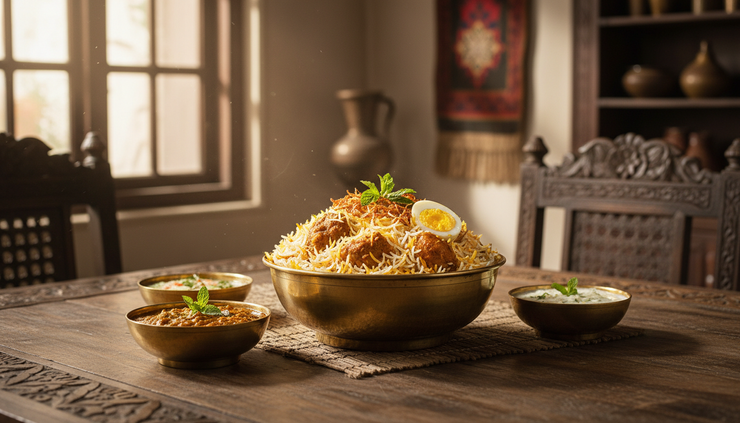
Image shows: Overhead view of Hyderabadi biryani served with mirchi ka salan and raita..
Hyderabad’s food heritage grew from many kitchens
Hyderabadi cuisine has a distinct personality because it absorbed ideas from many places without losing its local soul. The city’s food reflects the influence of the Nizams, Deccan households, Persian and Central Asian cooking, and regional produce from Telangana.
This mix shows up in the way Hyderabad cooks. Rice is layered with meat and spices. Lentils and wheat are slow-cooked until they turn creamy. Tea is brewed strong and served with biscuits that have become local icons. Spices build flavour rather than only heat.
Some common flavour markers include:
Saffron, cardamom, cloves, cinnamon, and bay leaves
Fresh mint and coriander
Fried onions, often called birista
Green chillies and sour elements
Slow-cooked meat
Rich gravies balanced with yoghurt or tamarind
Hyderabad’s food also has a strong social side. Biryani appears at weddings, festivals, Sunday lunches, and late-night gatherings. Haleem becomes a seasonal ritual during Ramzan. Irani chai works at any hour, whether before work, after college, or between shopping stops in the old city.
That is why the famous foods of Hyderabad are more than dishes on a menu. They are part of how the city gathers, celebrates, and remembers.
Hyderabadi biryani is the dish that defines the city
No food is more closely linked to Hyderabad than biryani. It is rich, aromatic, and carefully balanced. At its best, Hyderabadi biryani does not taste like rice mixed with curry. It tastes like every grain has carried flavour from the meat, spices, steam, and time.
Hyderabadi biryani is usually made with basmati rice, marinated meat, whole spices, fried onions, mint, coriander, yoghurt, and ghee. The meat is often mutton or chicken, though mutton biryani has a special place in the city’s food culture.
The most celebrated style is kachchi biryani, where raw marinated meat and partially cooked rice are layered together and cooked on dum. Dum cooking means the pot is sealed so the ingredients cook in their own steam. This method needs skill. The rice must stay separate, the meat must turn tender, and the spices must reach every layer without becoming harsh.
The history behind Hyderabadi biryani
Biryani has roots across the wider Persianate and Mughal food world, but Hyderabad shaped it into something unmistakably its own. Under the Nizams, royal kitchens refined rice and meat dishes with local tastes. The Deccan’s love for tang, spice, herbs, and slow cooking gave Hyderabadi biryani its own character.
One reason biryani became so loved is its ability to suit both grandeur and comfort. It can be served at a royal feast, but it also works as a family meal on a weekend. In Hyderabad, biryani is not reserved only for rare occasions. It is everyday luxury.
What makes the flavour unique
Hyderabadi biryani stands apart because of contrast. The rice is fragrant but not bland. The meat is deeply spiced but not hidden under gravy. The fried onions add sweetness. Mint and coriander bring freshness. Saffron or saffron-coloured milk adds aroma and warmth.
The accompaniments matter too. Biryani is often served with:
Mirchi ka salan
A curry made with green chillies, peanuts, sesame seeds, coconut, tamarind, and spices.
Dahi ki chutney or raita
A cooling yoghurt side with onions, herbs, or green chillies.
Together, they create balance. The salan adds nutty sourness. The raita cools the palate. The biryani remains the centre of the plate.
Dishes in this image: Close-up of a sealed handi being opened to release steam from Hyderabadi biryani.
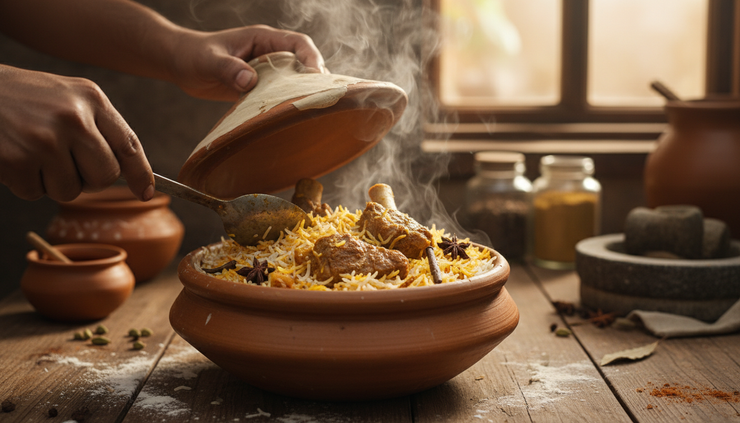
Image shows: Close-up of a sealed handi being opened to release steam from Hyderabadi biryani..
Haleem is Hyderabad’s slow-cooked Ramzan favourite
Haleem is one of Hyderabad’s most loved seasonal dishes, though many places now serve it at other times too. During Ramzan, it becomes a citywide craving. After sunset, people gather for bowls of hot, rich haleem topped with fried onions, mint, lemon, and sometimes ghee.
Haleem came to India through West Asian and Persian culinary routes and took a distinct form in Hyderabad. The local version became richer, spicier, and smoother over time. Today, Hyderabadi haleem has such a strong identity that it is recognised nationally and closely associated with the city’s Ramzan food culture.
What goes into Hyderabadi haleem
Haleem is made with meat, usually mutton, along with broken wheat, lentils, spices, and ghee. The ingredients are cooked for hours until they break down into a thick, smooth, almost paste-like texture. The dish is then beaten or mashed to bring the meat, grains, and lentils together.
Common ingredients include:
Mutton or other meat
Broken wheat
Chana dal and other lentils
Ginger and garlic
Whole spices
Ghee
Fried onions
Fresh mint
Lemon wedges
The texture is as important as the taste. Good haleem should feel rich and creamy without being heavy in a dull way. It should have depth from meat, warmth from spices, and brightness from lemon.
Why haleem matters in Hyderabad
Haleem is tied strongly to the month of Ramzan because it is nourishing after a day of fasting. It is filling, warm, and easy to eat. Yet its appeal goes beyond religious practice. In Hyderabad, haleem season brings people across communities to the same counters, queues, and tables.
It also shows the city’s patience with food. Haleem cannot be rushed. Its flavour comes from long cooking, repeated stirring, and careful finishing. That slow process is part of its charm.
A bowl of Hyderabadi haleem is not just a snack. It is a seasonal marker, a shared habit, and one of the clearest examples of Hyderabad’s food memory.
Irani chai keeps Hyderabad’s café culture alive
Irani chai is simple at first glance. It is tea with milk. Yet in Hyderabad, it has a place as important as any grand dish. It belongs to the city’s old cafés, where marble-top tables, glass jars of biscuits, and quick service create a mood that is hard to copy.
Irani cafés came to Hyderabad through Persian and Iranian migrant communities. Over time, these cafés became part of everyday city life. They served strong tea, affordable snacks, and a place to sit. People came to read newspapers, meet friends, discuss politics, write, study, or pause between errands.
What makes Irani chai different
Irani chai is usually stronger and creamier than regular tea. The tea decoction and milk may be prepared separately, then combined while serving. The milk is often slow-boiled, giving the chai a fuller body and slightly caramel-like feel.
The result is a cup that tastes bold, sweet, and milky. It pairs beautifully with Hyderabad’s famous biscuits and café snacks.
Classic pairings include:
Osmania biscuits
Salty-sweet, crumbly biscuits that are perfect for dipping.
Khari biscuits
Flaky, light, and buttery.
Bun maska
Soft bun served with butter, often enjoyed with hot chai.
Samosa
A crisp snack that makes chai feel more like a small meal.
Irani chai is not only about taste. It is about rhythm. A cup can be quick, taken standing near a counter, or slow, stretched over conversation. This makes it one of the famous foods of Hyderabad that travellers should not miss, even though it is a drink.
Dishes in this image: Eye-level view of Irani chai served with Osmania biscuits in an old Hyderabad café.

Image shows: Eye-level view of Irani chai served with Osmania biscuits in an old Hyderabad café..
The supporting dishes complete the Hyderabad food trail
Biryani, haleem, and Irani chai get the most attention, but Hyderabad’s food story is wider. Several other dishes help complete the experience, especially for travellers who want to taste beyond the headline names.
Dish | What it is | Why it matters |
Bagara baingan | Baby brinjals in a nutty, tangy gravy | A classic side at festive meals |
Mirchi ka salan | Green chillies cooked in peanut, sesame, coconut, and tamarind gravy | The signature biryani companion |
Double ka meetha | Bread, milk, sugar, ghee, and nuts | A popular Hyderabadi dessert |
Qubani ka meetha | Stewed apricots often served with cream or custard | A royal-style sweet with Persian influence |
Marag | A thin, spiced mutton soup | Often served at weddings and special meals |
Pathar ka gosht | Meat cooked on a heated stone slab | Known for smoky, direct heat flavour |
These dishes show how Hyderabad handles richness. Nuts, seeds, tamarind, dried fruits, meat, and spices appear often, but the cooking is not one-note. Sourness cuts through creamy gravies. Herbs freshen heavy dishes. Sweets use milk, fruit, bread, or nuts in different ways.
For a balanced food trail, mix heavy dishes with lighter stops. A biryani lunch, an evening Irani chai, and a dessert after dinner can feel more enjoyable than trying everything in one sitting.
How to enjoy Hyderabad’s food like a thoughtful traveller
Hyderabad rewards curiosity. The best meals often come from knowing how the city eats, not only what it eats.
Start with biryani when hungry. It deserves attention. Notice the rice first, then the meat, then the salan and raita. A good biryani should still taste fragrant after several bites.
Try haleem during Ramzan if possible. Many shops serve it fresh in the evening, and the atmosphere adds to the experience. If visiting outside the season, check whether the place is known for making it regularly rather than treating it as an afterthought.
Make time for Irani chai in the morning or late afternoon. Order Osmania biscuits with it. The biscuit’s salty-sweet taste explains why the pairing has lasted so long.
A few practical tips help:
Share portions when tasting multiple dishes.
Ask whether a biryani is mutton, chicken, kachchi, or pakki style.
Keep room for sides, especially mirchi ka salan.
Carry water, as some dishes can be rich and spicy.
Visit older neighbourhoods with patience, especially around popular meal times.
Food in Hyderabad is not only about restaurants. It lives in bakeries, wedding menus, Ramzan stalls, old cafés, and home kitchens. Each setting tells a different part of the story.
Dishes in this image: Wide-angle view of a Hyderabad food spread with biryani, haleem, Irani chai, and sweets on a dining table.
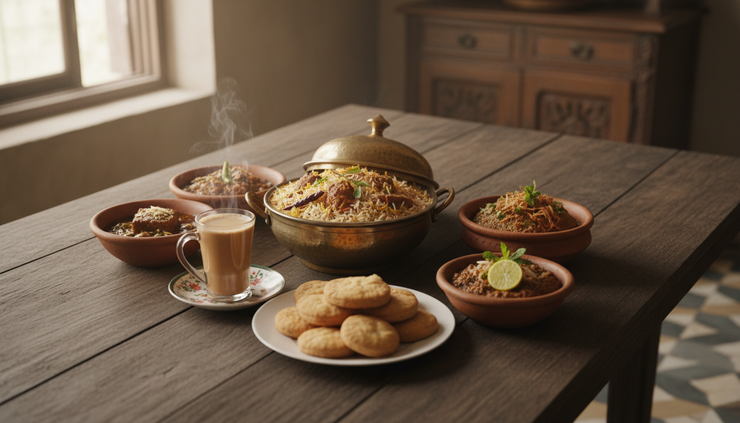
Image shows: Wide-angle view of a Hyderabad food spread with biryani, haleem, Irani chai, and sweets on a dining table..
Hyderabad’s flavours stay with you
The famous foods of Hyderabad carry the city’s past into the present without feeling frozen in time. Biryani speaks of royal kitchens and family celebrations. Haleem brings slow cooking, Ramzan evenings, and shared anticipation. Irani chai preserves the comfort of old cafés and everyday conversation.
Together, they explain why Hyderabad remains one of India’s great food cities. The flavours are bold, but they are also careful. The dishes are rich, but they have balance. The traditions are old, but people keep them alive every day with every order, every pot, and every cup.
For the most memorable food experience, do not rush from one dish to the next. Sit with the biryani. Wait for the haleem. Sip the chai slowly. Hyderabad tastes best when given time.
Travel, landmark, location, and shop information is based on publicly available online data at the time of writing. Details such as names, addresses, opening hours, availability, prices, and operating status may change. Please verify current details directly with the venue or official source before visiting.
Explore more city food guides
Continue exploring Indian food, landmarks and local markets: Pune · Surat · Srinagar · Leh · Port Blair


Comments