
Famous Foods of Bengaluru History Culture and Must Try Local Dishes

Bengaluru eats early, drinks coffee often, and treats breakfast with the seriousness other cities reserve for dinner. A plate of crisp dosa, a steel tumbler of filter coffee, a bowl of bisi bele bath, or a biryani served in a leaf cup can tell you a lot about the city’s past.
The food here grew from many kitchens. Old Pete markets, temple streets, military hotels, Udupi tiffin rooms, Iyengar bakeries, Anglo-Indian homes, Tamil messes, Andhra meals, and North Indian snack stalls all shaped the city’s appetite. That mix is why the Famous foods of Bengaluru are not limited to one style. They move from soft idlis to spicy biryani, from ragi mudde to honey cake, from home-style rice dishes to bakery puffs eaten on the pavement.
Dishes in this image: Overhead view of Bengaluru breakfast with dosa, idli, vada, chutney, and filter coffee
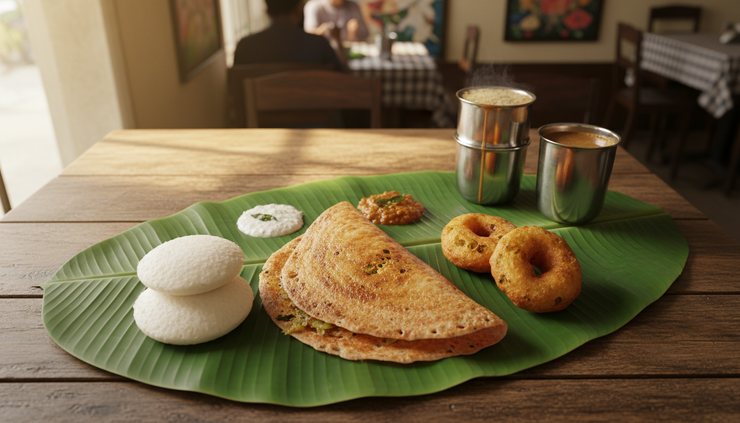
Image shows: Overhead view of Bengaluru breakfast with dosa, idli, vada, chutney, and filter coffee.
Bengaluru’s food story grew from many kitchens
Bengaluru began as a market town and military point, then became a city of gardens, colleges, factories, public sector offices, and technology parks. Each phase brought people from other regions, and food followed them.
Old Bengaluru was strongly linked to the agrarian food of southern Karnataka. Millets such as ragi, rice, lentils, coconut, jaggery, ground spices, and seasonal vegetables formed the base of everyday meals. Ragi mudde, saaru, palya, and curd were not restaurant novelties. They were practical, filling foods made for long working days.
The city’s tiffin culture came from a different but connected stream. Udupi-style eateries helped turn dosa, idli, vada, upma, kesari bath, and filter coffee into dependable public food. These restaurants were clean, quick, and affordable. They served clerks, students, travellers, and families who wanted a meal outside without fuss.
The cantonment area added another layer. Under colonial rule, this part of the city saw bakeries, clubs, military messes, and a taste for bread, cutlets, stews, and meat dishes. Anglo-Indian and Tamil influences still show up in old neighbourhoods through chops, roasts, biryanis, egg puffs, and strong tea.
Later, waves of migration widened the menu. Andhra meals brought fiery podi, pappu, and gongura. Tamil messes kept sambar rice and curd rice close to working life. Malayali eateries served parotta and beef fry where permitted. North Indian chaat, Punjabi food, and street snacks became common. The modern city kept absorbing without losing its old breakfast soul.
Bengaluru’s food culture is not one single cuisine. It is a city habit built around tiffin, coffee, rice, millets, bakeries, and meals from every community that settled here.
The breakfast classics define the city
Breakfast is the best place to start any food trail in Bengaluru. The city’s famous morning dishes are simple at first glance, but each has a long history of technique, patience, and local taste.
Benne masala dosa is crisp, rich, and beloved
Benne masala dosa means butter masala dosa. The dosa is thicker and softer than the very thin paper dosa, with a crisp outer surface and a generous smear of butter. Inside, there is usually a potato palya made with turmeric, onions, green chillies, and mustard seeds.
In old Bengaluru darshinis and tiffin rooms, dosa is not a slow brunch item. It arrives hot, often on a steel plate, with chutney and sambar. The joy lies in timing. Eat it while the edges are crisp and the butter is still melting into the surface.
The roots of dosa go deep into South Indian food history, with variations across Karnataka, Tamil Nadu, Kerala, and Andhra Pradesh. Bengaluru made its own versions through neighbourhood restaurants, family-run eateries, and standing-room breakfast counters.
Idli, vada, and sambar are everyday comfort
Idli and vada are found across South India, but Bengaluru serves them with a local rhythm. Idlis are soft, mild, and ideal for soaking up sambar. Vadas bring crunch, pepper, curry leaves, and the taste of urad dal. Together, they form a breakfast that works for schoolchildren, office-goers, and older residents alike.
The real point of difference often lies in the chutney. Many Bengaluru eateries serve coconut chutney that is thin, fresh, and slightly spicy. Some places are known for chutney so good that the idli becomes a vehicle for it.
Chow chow bath shows the city’s love for balance
Chow chow bath is a plate with two halves: khara bath and kesari bath. Khara bath is a savoury semolina dish, related to upma, cooked with vegetables, spices, curry leaves, and ghee. Kesari bath is sweet, soft, and usually flavoured with saffron colour, sugar, ghee, and sometimes pineapple.
This sweet-savoury pairing captures a very Bengaluru idea of tiffin. The meal is quick, filling, affordable, and balanced by contrast. It also reflects the old restaurant culture where small portions helped diners taste more than one thing without ordering a full meal.
Dishes in this image: Close-up of benne masala dosa with potato filling and coconut chutney
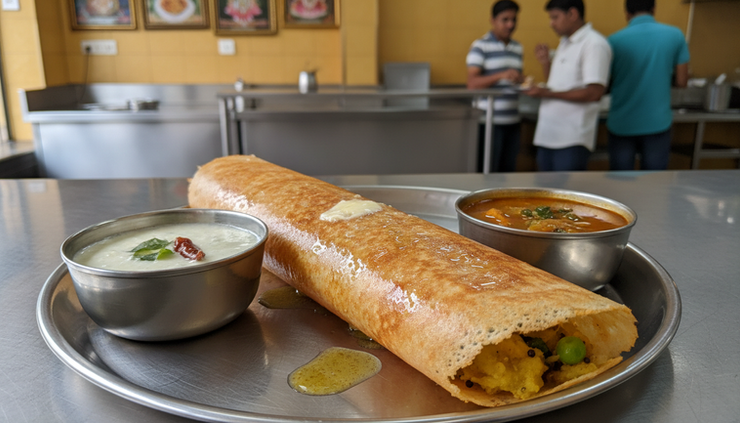
Image shows: Close-up of benne masala dosa with potato filling and coconut chutney.
Rice, ragi, and home-style dishes carry old Karnataka roots
While dosa gets much of the attention, Bengaluru’s deeper food memory sits in rice dishes, millet meals, and vegetable sides. These are the foods that connect the city to farming communities and home kitchens across southern Karnataka.
Bisi bele bath is a meal in a bowl
Bisi bele bath means hot lentil rice. It combines rice, toor dal, vegetables, tamarind, spices, and ghee into a thick, warm dish. The masala gives it depth, while tamarind adds a gentle sourness. It is often served with boondi, chips, khara mixture, or a spoon of ghee.
The dish is closely tied to Karnataka cuisine and has become a regular item in Bengaluru homes, canteens, darshinis, and wedding meals. Its appeal is practical. It is filling, easy to serve, and tastes even better when the spices are well roasted.
Ragi mudde speaks of the region’s farming past
Ragi mudde is a ball made from finger millet flour and water. It is usually eaten with saaru, bassaru, or a spicy curry. The texture is soft and dense, and it is swallowed in small portions rather than chewed like rice.
Ragi grows well in dry parts of Karnataka, which made it an important grain long before polished rice became widely available to everyone. In Bengaluru, ragi mudde remains a link to rural Karnataka. Many restaurants now serve it as a heritage dish, but for many households, it is still normal food.
Akki rotti and thatte idli show regional variety
Akki rotti is a rice flour flatbread, often mixed with onions, green chillies, coriander, cumin, and grated coconut. It is cooked on a tawa until crisp in places and soft in others. It pairs well with chutney, butter, or vegetable curry.
Thatte idli, meaning plate idli, is larger and flatter than the usual idli. It is linked with towns around Bengaluru, especially on highway food routes. Soft, wide, and satisfying, it reflects how regional dishes travel into the city through commuters, travellers, and family food memories.
Dish | Cultural root | Best way to enjoy it |
Bisi bele bath | Karnataka home and temple-style cooking | Hot, with ghee and crunchy boondi |
Ragi mudde | Millet-based farming food | With saaru or spicy curry |
Akki rotti | Southern Karnataka home kitchens | Fresh from the tawa with chutney |
Thatte idli | Regional tiffin culture around Bengaluru | With sambar and coconut chutney |
Bakeries, coffee, and snacks shaped modern Bengaluru
Bengaluru’s snack culture is as important as its meals. A lot of the city’s food nostalgia lives in its bakeries, coffee houses, and evening street stalls.
Filter coffee is a daily ritual
Bengaluru filter coffee is usually served in a steel tumbler and dabarah. Hot milk meets a strong decoction made from finely ground coffee, often with chicory. The drink is poured back and forth to cool it and create foam.
Coffee became central to the city partly because Karnataka is one of India’s major coffee-growing states. Bengaluru, as an urban centre, turned that supply into a public ritual. A quick coffee after breakfast, a late afternoon cup with a snack, or a meeting at an old coffee house is part of the city’s social life.
Iyengar bakeries changed the snack map
Iyengar bakeries are a distinct part of Bengaluru’s food identity. Many are small neighbourhood bakeries selling fresh bread, vegetable puffs, khara buns, dilpasand, coconut biscuits, masala toast, and honey cake.
These bakeries brought together Indian flavours and bakery techniques. The vegetable puff is a perfect example. It uses layered pastry, but the filling tastes familiar, with potato, onion, peas, chilli, and spices. Honey cake, with its soft sponge, jam layer, and coconut topping, became a childhood memory for many Bengaluru residents.
Chaat and street snacks belong to the evening
As the city grew, chaat stalls became part of school roads, markets, and residential areas. Masala puri is especially loved in Bengaluru. It is made with crushed puris, peas gravy, chutneys, onions, coriander, and sev. Unlike the drier chaats of some northern cities, Bengaluru-style masala puri is warm, saucy, and spoonable.
You will also find gobi manchurian, pani puri, bajji, bonda, and corn carts. These dishes show the city’s habit of adapting outside influences to local taste. The spice level, texture, and serving style often shift from area to area.
Dishes in this image: Eye-level view of filter coffee served with a vegetable puff in a Bengaluru bakery

Image shows: Eye-level view of filter coffee served with a vegetable puff in a Bengaluru bakery.
Meat dishes and biryani reveal another side of Bengaluru
Bengaluru’s food image often starts with vegetarian tiffin, but the city has a strong non-vegetarian tradition too. Military hotels, old markets, and community kitchens have kept meat dishes central to local eating.
Donne biryani is bold and local
Donne biryani is one of the most famous foods of Bengaluru for meat lovers. It is served in a donne, a bowl made from areca palm leaf. The biryani is usually greenish or brownish from herbs, chillies, and spices, and it is cooked in a style different from Hyderabadi dum biryani.
The rice is shorter, the masala is punchy, and the meat is often the focus. Mutton and chicken versions are common. Many places serve it with raita, boiled egg, or a thin curry on the side.
The use of donne is more than presentation. Leaf bowls were practical, local, and biodegradable long before that became a modern selling point. They also give the dish a rustic street-food identity.
Military hotels keep old meat traditions alive
Military hotels in Bengaluru are old-style eateries known for non-vegetarian food, especially mutton dishes. The name does not always mean they served the army directly. In popular understanding, it points to places that served meat at a time when many mainstream eateries were vegetarian.
Typical dishes include mutton chops, kheema, liver fry, chicken fry, biryani, and ragi mudde with meat gravy. These hotels show how the city’s working-class food culture developed alongside its vegetarian darshini culture. Both are Bengaluru, and both matter.
Neighbourhood meals reflect migration
Bengaluru’s non-vegetarian food is also shaped by communities from Tamil Nadu, Kerala, Andhra Pradesh, coastal Karnataka, and North India. That is why one can find Andhra chilli chicken, Kerala-style parotta with curry, Mangalorean fish dishes, Tamil meals, kebabs, and grills across the city.
Food here rarely stays locked in one community. A dish arrives with migrants, finds regular customers, changes a little, and becomes part of the city’s broader menu.
Dishes in this image: Three-quarter view of donne biryani served in an areca leaf bowl with boiled egg and raita
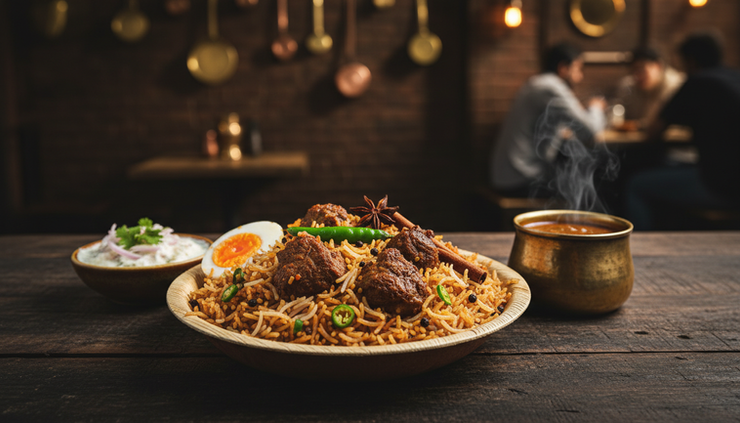
Image shows: Three-quarter view of donne biryani served in an areca leaf bowl with boiled egg and raita.
How to taste Bengaluru like a local
The best way to understand the famous foods of Bengaluru is to spread them across the day. Do not try to eat everything in one sitting. The city’s food makes more sense when matched to time and place.
Start the morning with a tiffin breakfast. Choose idli-vada if you want comfort, benne masala dosa if you want richness, or chow chow bath if you want variety. Follow it with filter coffee.
For lunch, try bisi bele bath, ragi mudde with saaru, or a full Karnataka meal with rice, sambar, rasam, palya, pickle, curd, and payasa. If you eat meat, a military hotel lunch with donne biryani or mutton curry gives a different view of the city.
Evening belongs to bakeries and chaat. A vegetable puff with coffee, masala puri from a neighbourhood stall, or a slice of honey cake can be as memorable as a famous restaurant meal.
Dinner can be simple. Many Bengaluru homes still prefer rice, rasam, curd, and a vegetable side at night. Restaurants may be louder and richer, but the city’s food culture also respects light, familiar meals.
A useful food trail could look like this:
Morning
Benne masala dosa, idli-vada, or chow chow bath with filter coffee
Lunch
Bisi bele bath, ragi mudde, Karnataka meals, or donne biryani
Evening
Vegetable puff, honey cake, masala puri, or bajji
Dinner
Akki rotti, thatte idli, rice meals, kebabs, or a regional mess meal
When ordering, pay attention to the accompaniments. Chutney, sambar, saaru, palya, raita, and podi often carry the real local flavour. Bengaluru food is not only about the main dish. It is about how everything on the plate works together.
Dishes in this image: Wide-angle view of a Bengaluru food table with ragi mudde, bisi bele bath, akki rotti, and chutneys

Image shows: Wide-angle view of a Bengaluru food table with ragi mudde, bisi bele bath, akki rotti, and chutneys.
Bengaluru’s food is often described through its restaurants, but its real strength is continuity. A student eating idli before class, a family buying puffs from a local bakery, a worker ordering ragi mudde at lunch, and friends meeting over filter coffee are all part of the same story.
To taste the city well, look beyond checklists. Eat one old breakfast, one millet or rice dish, one bakery snack, one cup of coffee, and one meal from a community kitchen or military hotel. That route gives a fuller sense of Bengaluru than any single plate can.
Travel, landmark, location, and shop information is based on publicly available online data at the time of writing. Details such as names, addresses, opening hours, availability, prices, and operating status may change. Please verify current details directly with the venue or official source before visiting.
Explore more city food guides
Continue exploring Indian food, landmarks and local markets: Pune · Surat · Srinagar · Leh · Port Blair


Comments